Something is shifting in Miami’s electronic music identity. Latin afro house Miami, a sound built on the collision of pan-Latin percussion, Afrobeat groove structures, and club-ready electronic production, is rewriting the city’s sonic DNA. INVT, the Miami-bred duo whose new ten-track album 8 AM Swim drops June 3rd, 2026, offers the clearest case study yet of what this subgenre can be when it stops borrowing and starts building. This is the blueprint: Latin rhythms threaded through dub, garage, tech house, and Miami bass, produced entirely by two people who grew up hearing all of it at once.
Defining Latin Afro House Music
Latin afro house music is a production style that layers Latin percussion patterns (clave, tumbao, güiro textures) over the polyrhythmic kick-and-shaker frameworks of South African afro house, typically landing between 118 and 126 BPM. The result is dance music that carries both the hip-driven swing of cumbia or salsa and the hypnotic repetition of Johannesburg’s deep house lineage. It is not a remix trend; it is a structural fusion where neither source dominates.
The crossover has been building for years in Ibiza, where afro house residencies at Hï Ibiza and Ushuaïa now run six nights a week across the 2026 season. Francis Mercier’s Solèy residency, for instance, explicitly programs Latin house alongside afro house and deep house, treating the overlap as a given rather than an experiment. That programming decision reflects what DJs on the ground already know: these records sit together in a set because the rhythmic DNA is compatible.
What are the core elements?
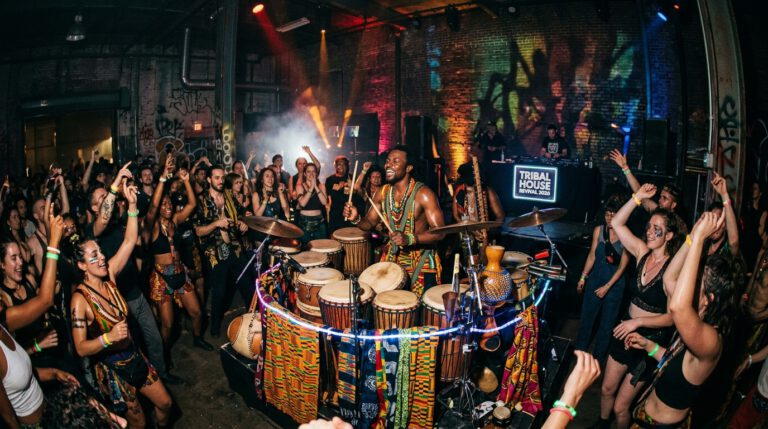
The core elements of Latin afro house are layered percussion (congas, djembe patterns, shakers running against syncopated claves), vocal chops that reference both Yoruba chant traditions and Spanish-language melodic phrasing, and a low-end that favors warmth over sub-bass aggression. The groove is designed to move hips, not rattle chest cavities. Producers like BATUIN, whose track “Makuma” is explicitly tagged as Latin afro house, build around organic instrumentation processed through electronic filters, keeping the human feel intact beneath the grid. If you want to understand how afro house differs from amapiano, the rhythmic emphasis here sits even further from log-drum patterns and closer to Caribbean syncopation.
How does it differ from other genres?
The Latin afro house differences from standard afro house come down to melodic structure and rhythmic accent. Where South African afro house leans on pentatonic vocal scales and log-drum bass, Latin afro house introduces harmonic minor tonalities, piano montunos, and brass stabs rooted in salsa and son cubano. Compared to Latin tech house, the tempo is often slower, the percussion more acoustic, and the arrangement more patient. I’ve played Latin tech house records back to back with Latin afro house tracks, and the floor responds differently to each: one drives forward, the other pulls you into a circular groove that rewards staying in the pocket. The distinction matters for DJs programming sunrise sets or open-air stages where aggression kills the mood.
Key Artists Shaping the Genre
The leading Latin afro house artists right now operate at the intersection of club credibility and cultural specificity. INVT sit at the center of this conversation as Miami natives who fuse tech house, dub, and garage with pan-Latin rhythms. Their 2024 collaborative EP Tectónica with Introspekt and the LOCA EP with K-LONE on The Martinez Brothers’ label established their production vocabulary before the album expanded it.
Beyond INVT, the genre draws energy from adjacent figures. Black Coffee’s influence on global afro house opened doors that Latin-rooted producers now walk through, while Bedouin’s Middle Eastern melodic sensibility shares structural DNA with the genre’s approach to layered percussion and vocal mysticism. Francis Mercier’s Deep Root Records label has become a curatorial hub, and producers working the darker afrotech corridor frequently cross-pollinate with Latin afro house on festival bills.
Who are the leading figures?
The leading figures in Latin afro house span geography and approach. INVT represent the Miami axis, grounding their sound in South Florida’s bass music heritage while reaching toward Caribbean and Latin American melodic traditions. In Mexico, tribal house producers have been folding afro house percussion into their sets for years, creating a pipeline that feeds the Latin afro house conversation from the south. Last year, INVT played Draaimolen, Primavera Sound, EDC Vegas, and Circoloco Ibiza, placing their pan-Latin sound on stages typically dominated by European and South African selectors.
What contributions have they made?
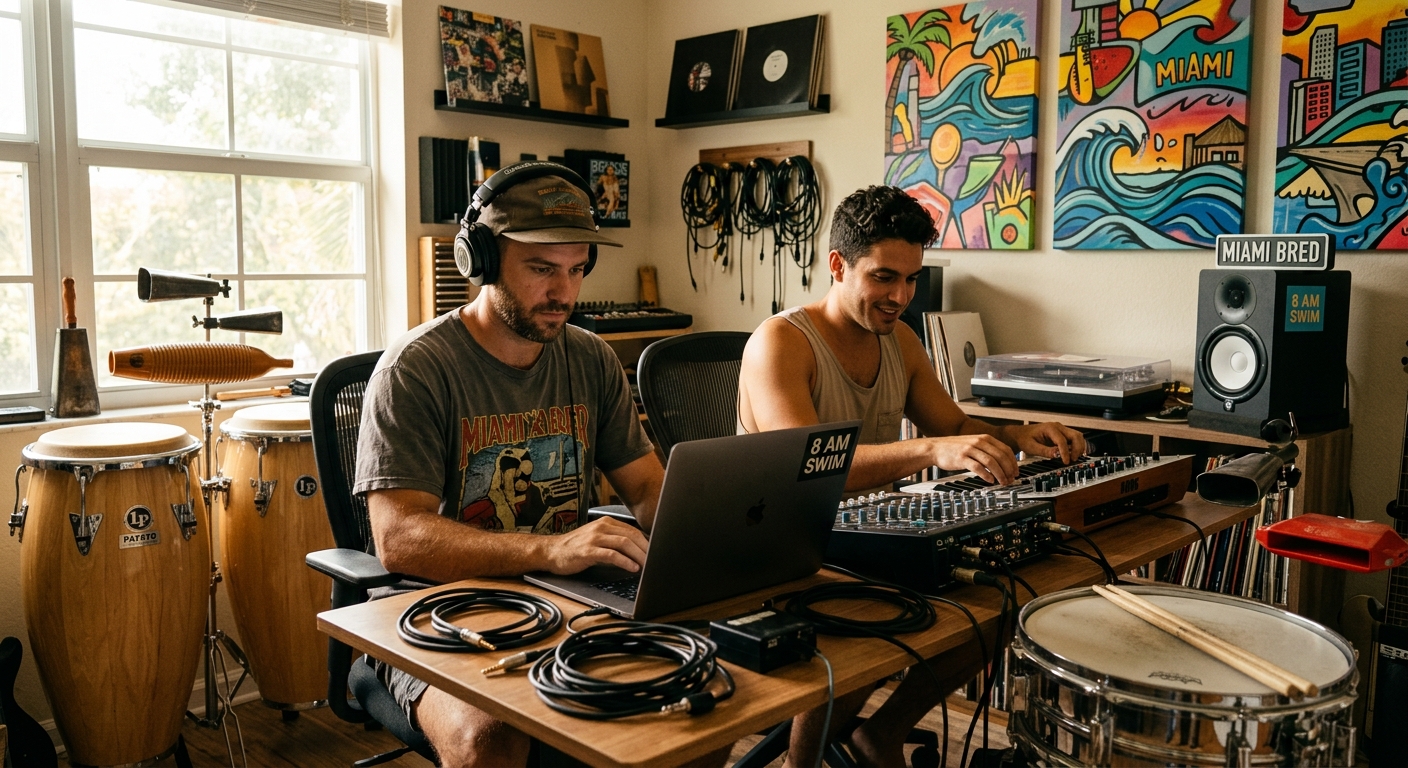
The contributions of Latin afro house artists center on proving that Latin rhythms can anchor a full-length electronic album, not just a remix or a festival edit. INVT’s decision to self-release 8 AM Swim and handle production, mixing, and mastering entirely in-house signals a DIY ethos borrowed more from Miami bass culture than from major-label electronic music. That independence lets them sequence tracks like “SALSA SWING” next to “SHORELINE DUB” without A&R interference flattening the range. The result is a record that functions as genre definition by example.
INVT’s 8 AM Swim: A Case Study
INVT’s 8 AM Swim is a ten-track album that pairs groovy tech house, dub, garage, and Miami bass with the duo’s signature pan-Latin rhythms, according to Resident Advisor’s announcement. Scheduled for June 3rd, 2026, it arrives as a self-released project: no label mediation, no genre compromise. The lead single “LENS BLUR” previews a production style that treats Latin percussion as structural rather than decorative.
What makes this album a case study rather than just another release is its tracklist architecture. Songs titled “CARIÑOSA,” “AVENTURAS,” and “SOUTH FLORIDA EUFORIA” sit alongside “DIP TEK” and “WANT U,” mapping a sonic geography that runs from Havana to Wynwood to a London pirate radio frequency. I’ve heard records try to cover this much ground and collapse into genre tourism. The difference here is that INVT are not visiting these sounds; they grew up at the intersection.
What is the concept behind 8 AM Swim?
The concept of 8 AM Swim evokes a specific Miami ritual: the morning after a long night, when the city’s humidity meets the Atlantic and everything feels suspended between exhaustion and clarity. That liminal space, post-club but pre-reality, shapes the album’s pacing. It is not a peak-time record. It is a record for the hours when the party has ended but the feeling hasn’t, and the pool water is still warm. That emotional register is rare in electronic music, which usually optimizes for either the dancefloor or the headphone commute, not the in-between.
How does it exemplify the genre?
The 8 AM Swim genre exemplification works because the album refuses to flatten its influences into a single tempo or mood. “SALSA SWING” carries the rhythmic DNA of son cubano through an electronic filter; “SHORELINE DUB” pulls from Jamaican sound system culture; “TIEMPO” sits in a reflective pocket that could soundtrack a golden hour set on a Biscayne Bay rooftop. Across all ten tracks, the Latin afro house identity holds because the percussion philosophy stays consistent: organic, layered, and syncopated against the grid rather than locked to it.
Cultural Impact of Latin Afro House
Latin afro house is reshaping Miami’s music scene by giving the city a homegrown electronic identity that reflects its actual demographics. Miami has always been a Latin city with deep Caribbean and African diasporic roots, but its electronic music reputation historically centered on Ultra Music Festival’s mainstage EDM or the Winter Music Conference’s industry networking. The cultural impact of Latin afro house is that it finally connects Miami’s club music to the sounds its residents actually grew up hearing at home.
As ArtburstMiami reported, the city’s cultural identity is “built from the continuous interaction between Caribbean, Latin American, Haitian, American, European and African-American influences.” Latin afro house is the electronic music expression of that reality, not an import but a local product.
How is it influencing Miami’s music scene?
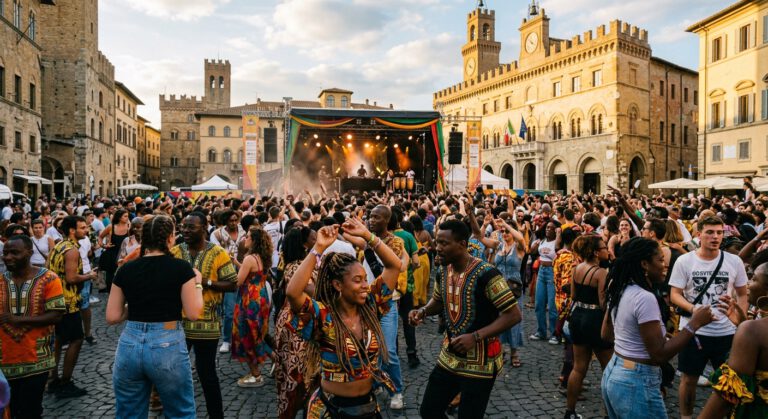
The influence on Miami’s music scene shows up in programming decisions. Promoters who once booked strictly tech house or melodic techno lineups now include Latin afro house selectors on bills alongside those acts, recognizing that the audience overlap is real. I watched a room at a Wynwood warehouse shift from polite nodding during a melodic techno set to full-body movement the moment a Latin afro house DJ dropped a conga-driven groove at 122 BPM. That physical response is hard to fake, and promoters notice it.
What role does it play in nightlife?
The role in nightlife is functional, not just aesthetic. Latin afro house fills a programming gap between the aggression of peak-time techno and the passivity of ambient deep house. It keeps people dancing without exhausting them, which makes it ideal for outdoor venues, rooftop parties, and the extended Sunday sessions that define Miami’s warm-weather club calendar. The genre’s rhythmic complexity rewards attentive listening while its groove accessibility means casual dancers never feel excluded. That dual function is why it works in rooms where afro house has already found traction in other American cities.
The Future of Latin Afro House
Emerging trends in Latin afro house point toward deeper collaboration between Latin American producers and African electronic artists, creating a transatlantic creative exchange that mirrors historical musical connections between West Africa, the Caribbean, and South America. David Guetta recently noted how afro house has moved far beyond the underground, appearing in fashion events, beach clubs, and restaurants globally. The Latin variant is following the same trajectory but with a built-in audience advantage: the global Latin music market, already worth billions annually, provides a ready listener base that pure afro house cannot access alone.
The future of Latin afro house depends on whether its best producers can resist the formula trap that comes with commercial attention. The genre’s emotional and cultural essence is what made people connect with it; losing that to repetitive, trend-chasing production would be the fastest way to kill its momentum.
What trends are emerging in the genre?
The emerging trends in Latin afro house include Mexican tribal house producers incorporating afro house percussion into their sets, creating a south-to-north pipeline that feeds new rhythmic ideas into the Miami and Ibiza circuits. TikTok has accelerated this reach, with creators tagging Latin and afro house content together and driving streams toward producers who straddle both worlds. The Ibiza 2026 season, with its six-night-a-week afro house programming across multiple venues, is normalizing the Latin-afro crossover at the industry’s highest visibility level.
How might it evolve in mainstream music?
The evolution in mainstream music will likely come through feature collaborations and sync placements rather than radio singles. Latin afro house at 120 BPM sits in a tempo range that works for fitness content, fashion shows, and streaming playlist curation, all channels that bypass traditional radio gatekeeping. INVT’s self-release model for 8 AM Swim suggests that the genre’s most credible voices will maintain independence rather than sign to majors, keeping creative control while using algorithmic distribution to reach global audiences. The sound is too specific to survive dilution, and the producers who understand that will define the next chapter.