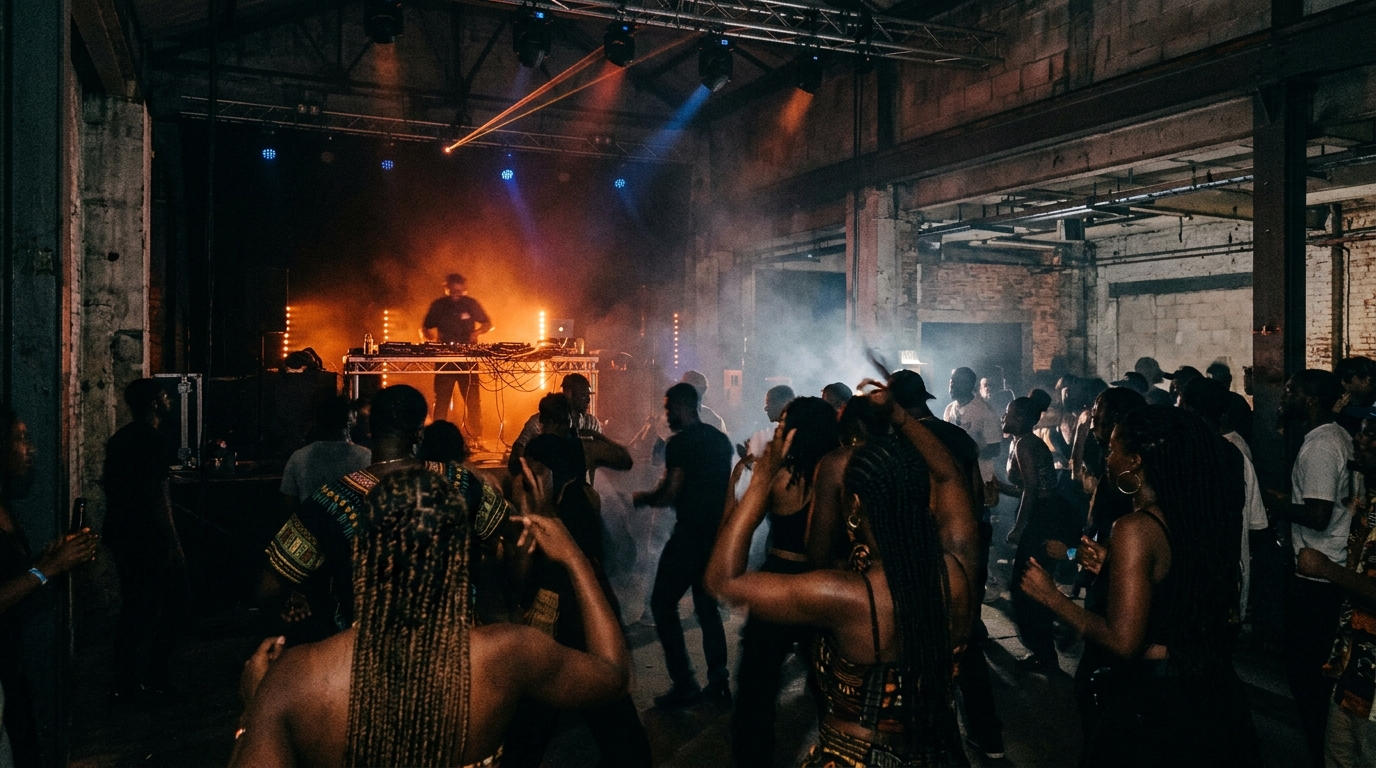
Something shifted in the low end. Sometime around 2022, a pocket of producers started stripping the sunshine out of afro house and replacing it with smoke, reverb, and tension. The afrotech music genre didn’t announce itself with a manifesto or a flagship compilation. It crept in through DJ sets that ran later, hit harder, and left the melodic sweetness behind. This is the sound that lives between the percussion-heavy warmth of Johannesburg and the concrete weight of a Berlin basement, and it’s rewriting what African-rooted electronic music can feel like after midnight.
Understanding the Afrotech Music Genre
The afrotech music genre is a darker, more atmospheric offshoot of afro house, built on deep basslines, layered African rhythms, and hypnotic repetition that trades uplift for tension. Most tracks sit between 120 and 126 BPM, slower than peak-time techno but heavier in texture than standard afro house. As Rolling Stone Africa’s analysis of afro house’s global rise notes, the broader genre already prioritizes groove and atmosphere over dramatic drops; afrotech pushes that atmospheric quality into genuinely dark territory.
Where afro house found its audience in Ibiza beach clubs and festival main stages, afrotech gravitates toward later time slots and smaller rooms. The distinction matters. It signals a music fusion that doesn’t need daylight or a poolside crowd to work. I’ve watched a room of 200 people lock into an afrotech set at 3 a.m. in a way that felt closer to a late-night Berlin session than anything coming out of the Afro house mainstream.
Origins of Afrotech Music
Afrotech origins trace back to South Africa’s electronic underground, specifically Johannesburg’s club circuit, where producers began folding darker synthesizer textures and industrial reverb into the percussion frameworks they’d inherited from afro house and deep house. The sound didn’t emerge in isolation. It drew from the same Johannesburg underground clubs that birthed afro house, but it pulled influence from European techno’s spatial design and minimal’s restraint. Producers like those in the orbit of labels releasing dark house and electronic music from the African continent pushed the template further from melody and closer to raw, repetitive groove.
Key Characteristics of Afrotech
The afrotech characteristics that separate it from its parent genre are specific and identifiable: sub-bass that sits lower and heavier, stripped-back melodic content, extensive use of delay and reverb on percussion, and a preference for tension over resolution. The kick drums carry more weight. The hi-hats are often filtered or buried. Where afro house builds to euphoric vocal moments, afrotech lets the groove do the emotional work, cycling through polyrhythmic patterns that feel almost industrial in their intensity. Think less Black Coffee, more warehouse at closing time.
Afrotech vs. Afro House: Key Differences
Afrotech differs from afro house primarily in mood, frequency range, and structural intent. Afro house leans warm, vocal-forward, and melodically rich; afrotech strips those elements back in favor of darker tonal palettes, deeper sub-bass, and longer, more hypnotic arrangements. The BPM range overlaps (both hover around 120 to 126), but the sonic weight distribution is fundamentally different.
The comparison matters because DJs programming sets need to understand that these two sounds serve different moments on a dance floor. Afro house opens rooms and builds energy in the early hours. Afrotech holds rooms that are already locked in. Mixing them carelessly creates tonal whiplash. The genre differences are functional, not just aesthetic, and anyone booking acts or building playlists for growing afro house scenes in cities like Boston needs to understand where one ends and the other begins.
Musical Elements Comparison
The afrotech musical elements lean heavily on subtractive arrangement. Where afro house stacks layers of percussion, vocal chops, and melodic hooks, afrotech removes until only the essential rhythmic skeleton and bass pressure remain. Synth pads, when present, run toward minor keys and long decay times. The result feels closer to deep techno than to any house subgenre, though the rhythmic DNA stays unmistakably African. Kick patterns still carry that distinctive swing; they just hit in a darker register.
Vocal Styles in Afrotech
Afrotech vocal styles favor abstraction over presence. Full vocal performances are rare. Instead, producers use chopped, pitched, and heavily processed vocal fragments as textural elements rather than melodic anchors. A Zulu phrase might appear as a single, reverb-drenched syllable looping across eight bars. The voice becomes percussion, not narrative. This is the sharpest break from afro house, where soulful, identifiable vocal performances often carry the emotional center of a track. In afrotech, emotion comes from the space between sounds.
Cultural Influences Shaping Afrotech
African heritage, European club architecture, and the global appetite for rhythm-driven electronic music all converge in afrotech. The cultural influences on afrotech are not a simple East-meets-West story; they reflect a generation of African producers who grew up listening to both traditional percussion and Berlin-era techno, and who refuse to choose between them.
The cultural fusion runs deeper than sampling. It’s structural. South African producers bring communal rhythmic sensibilities rooted in decades of township music and kwaito, then route those sensibilities through production techniques borrowed from minimal techno and dub. The result doesn’t sound borrowed. It sounds like something that could only come from someone holding both traditions simultaneously. I’ve heard sets in Lisbon where the DJ moved from a raw Joburg afrotech cut into a Tresor-era Detroit track and the transition was invisible; the Detroit-Tresor connection and the Johannesburg underground share more sonic DNA than most people realize.
Impact of African Heritage
African heritage in afrotech shows up most clearly in the polyrhythmic frameworks that anchor every track. These aren’t programmed imitations of African drumming; they carry the actual rhythmic logic of traditions passed through generations of South African music, from maskandi guitar patterns to gqom’s raw repetition. The percussion in afrotech doesn’t just reference African music. It thinks in African time signatures, layering 3-over-4 and 6-over-8 patterns in ways that European techno producers rarely attempt. That rhythmic complexity is the genre’s backbone, and it’s what keeps the music feeling alive even when every other element has been stripped to its darkest form.
Globalization and Afrotech
Globalization effects on afrotech have accelerated the genre’s spread without diluting its identity, at least not yet. Streaming platforms and SoundCloud have allowed Johannesburg producers to reach Berlin, London, and São Paulo listeners directly, bypassing the traditional label gatekeeping that slowed earlier African electronic movements. The Gondwana Festival’s bridging of African and European club culture is one example of how physical events now reinforce digital discovery. But the risk is real: as afrotech gains traction in European clubs, the temptation to soften its edges for broader appeal will grow. The producers who resist that pressure will define the genre’s next chapter.
The Future of Afrotech in Music Industry
The future of afrotech points toward wider recognition without guaranteed mainstream absorption. Unlike afro house, which found a comfortable home in luxury nightlife and festival circuits, afrotech’s darker palette resists easy commercialization. That’s its strength. The genre is more likely to follow the trajectory of deep techno or minimal: respected, influential, consistently booked, but never quite pop.
What’s changing is infrastructure. More labels are actively signing afrotech-adjacent releases. More promoters in cities like London, Amsterdam, and Lisbon are programming dedicated afrotech nights rather than folding the sound into generic „Afro“ lineups. The genre’s growth potential depends on whether this infrastructure develops fast enough to support the producers already making the music.
Emerging Artists in Afrotech
Emerging afrotech artists are coming primarily from South Africa’s Gauteng province and, increasingly, from diasporic communities in Western Europe. These producers often straddle multiple scenes, releasing on both African and European labels, playing both afro house events in cities like Los Angeles and darker techno nights in continental Europe. The ones to watch are those who refuse to simplify their sound for crossover appeal. The genre needs artists willing to stay in the tension, to keep the bass heavy and the melodies sparse, even as booking fees rise and festival slots open up.
Afrotech’s Growth Potential
Afrotech growth potential is significant but conditional. The genre sits at an intersection that the global dance music market is hungry for: rhythmically complex, culturally rooted, and sonically dark enough to satisfy the post-pandemic appetite for heavier club music, as Rolling Stone Africa documents. If afrotech maintains its identity, it could become the dominant late-night sound across multiple continents within five years. If it gets smoothed out for Spotify editorial playlists and sunset sets, it will dissolve into afro house and lose the very quality that makes it worth naming separately. The producers and labels making decisions right now will determine which path it takes.