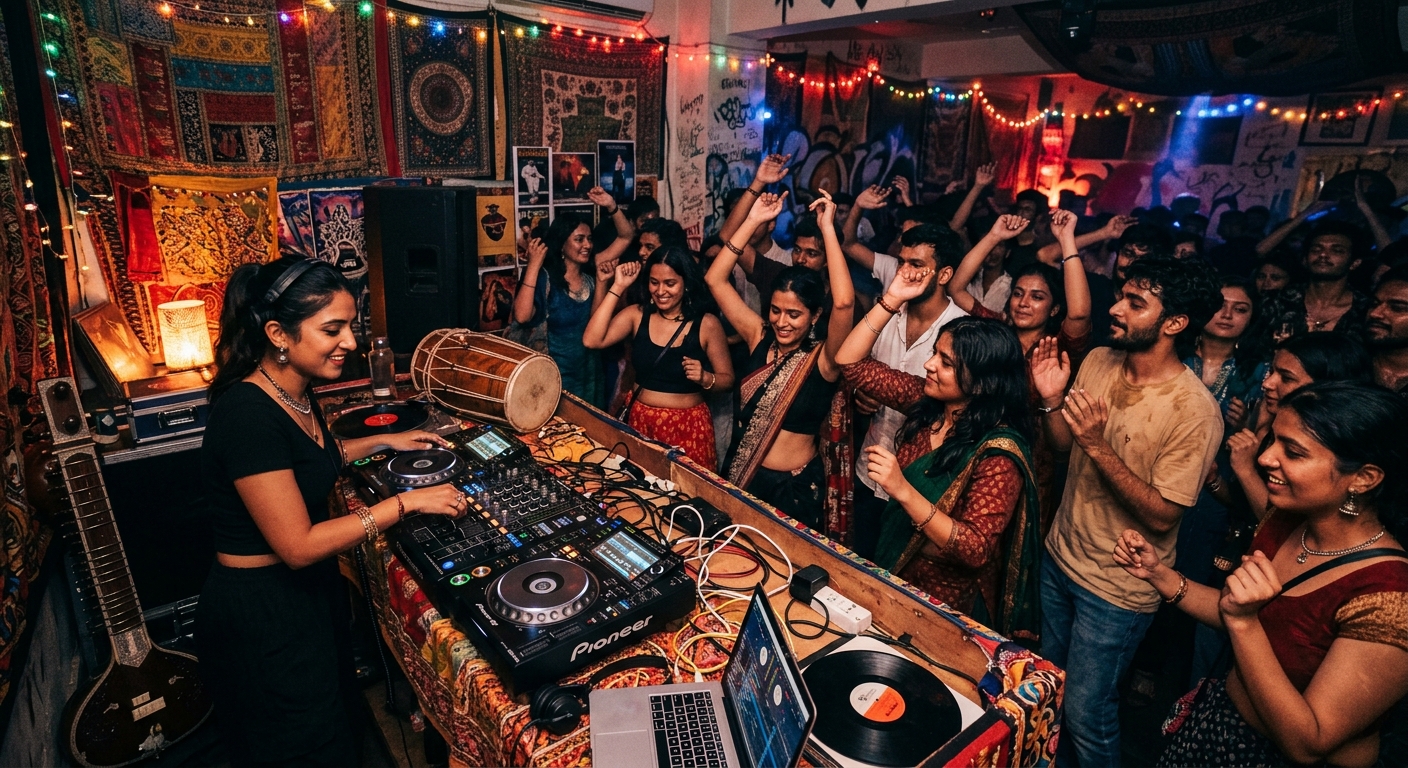
Something shifted. Not gradually, not politely, but with the force of a scene that spent years building pressure underground and is now breaking through concrete. South Asian underground electronic music labels 2026 are no longer footnotes in global club culture; they are writing new chapters entirely. From Mumbai basements to London warehouse raves to Lahore’s late-night streaming sessions, a generation of producers and DJs is pulling from classical ragas, Bollywood film scores, UK grime, and four-to-the-floor techno to build something that sounds like nowhere else and everywhere at once. The money is following. The majors are paying attention. And the floors are full.
Emerging Trends in South Asian Club Music
South Asian club music trends in 2026 center on aggressive genre hybridization and a refusal to stay inside any single lane. According to CNBC’s reporting on the South Asian music business, Spotify streams of Indian artists in international markets grew more than 2,000% between 2019 and 2023, with nearly 50% of royalties from Indian artists now coming from listeners outside India. That is not a niche statistic. That is a tectonic shift in who is listening and where the revenue flows.
The youth culture driving this is diasporic, bilingual, and genre-agnostic. Producers in cities like Delhi, Karachi, and Birmingham are not choosing between electronic music trends and traditional instrumentation; they are treating both as raw material. The South Asian soundscape of 2026 sounds like tabla patterns run through granular synthesis, like dhol rhythms underpinning 138 BPM trance breakdowns, like film dialogue chopped into percussive stabs over minimal techno frameworks.
What defines the current soundscape?
The current soundscape is defined by tension between heritage and velocity. Producers sample Sufi qawwali vocals and layer them over industrial kick drums. Sitar drones sit beneath acid basslines. The textures are warm and analog-feeling even when the production is entirely digital. I’ve heard sets in East London where a DJ dropped a reworked Nusrat Fateh Ali Khan phrase over a 130 BPM techno groove and the room went somewhere sacred and sweaty at the same time.
How are genres blending in 2026?
Genre blending in 2026 looks less like fusion and more like demolition. The old categories (desi bass, Asian Underground, Bollywood remix) have been replaced by producers who move fluidly between jungle, footwork, UK garage, and deep house within a single EP. This mirrors what’s happening in footwork and jungle hybrid scenes globally, but with a distinctly South Asian melodic and rhythmic vocabulary threaded through the center. The result is club music that does not ask permission to exist between genres.
Notable South Asian Artists Leading the Scene
The top South Asian artists in 2026 are not waiting for international recognition to arrive through traditional gatekeepers. They are building it through direct-to-fan channels, cross-continental collaborations, and label partnerships that did not exist five years ago. Artists like Diljit Dosanjh and Karan Aujla are selling out major live venues across the U.S. and Europe, with Dosanjh’s recent North American tour moving more than 100,000 tickets across its run, proving the commercial viability of South Asian music at scale. Vocalists and producers such as Priya Saraiya are gaining international traction by bridging traditional melodic sensibilities with contemporary electronic production, demonstrating that the scene’s reach extends well beyond any single artist or style.
But below that mainstream layer, the underground is where the most interesting music lives. Producers working across Mumbai, Colombo, and the UK diaspora are crafting sounds that carry cultural weight without sacrificing dancefloor function. Their artist collaborations span continents and languages, and their cultural impact is measured not just in streams but in how they are reshaping what club music can reference and still hit hard at 2 a.m.
Who are the top artists in 2026?
The top artists in 2026 span a wide spectrum. DJ Nucleya remains a gravitational force in Indian bass music, while a wave of emerging artists is pushing harder into experimental territory. Priya Saraiya’s work exemplifies the crossover potential of this generation: rooted in South Asian melodic tradition but fully fluent in the structural language of electronic club music. Producers from Pakistan, Sri Lanka, and Bangladesh are gaining traction alongside their Indian counterparts, creating a pan-South Asian electronic identity that resists reduction to any single national scene.
What unique styles are they exploring?
The unique styles range from deconstructed club music built on Carnatic rhythmic cycles to ambient pieces sampling field recordings from Himalayan villages. Some producers are working at 160 BPM, pulling from juke and footwork traditions, similar to what’s happening in the Tokyo footwork scene. Others slow things down to 95 BPM, building hypnotic grooves that owe as much to dub as to Bollywood playback singing. The common thread is intentionality: these are not novelty fusions but deeply considered sonic architectures.
Influential Underground Electronic Music Labels
Underground electronic music labels focused on South Asian artists are emerging as critical infrastructure for the scene. Dialled In Records, a UK-based label established in 2026, explicitly positions itself at the intersection of independent credibility and South Asian artistic identity, championing pioneering artists redefining contemporary sound. Meanwhile, 5 Junction, a joint venture between music executive Anjula Acharia and Warner Music Group, signals that major label investment is flowing into South Asian talent pipelines. The Bait soundtrack, released through this wave of culturally specific label activity, pulled together grime, desi hip-hop, jungle, and electronic music with South Asian film samples, and stands as a reference point for what label-backed curatorial ambition can produce when it is rooted in genuine cultural specificity rather than trend-chasing.
These labels operate differently from each other, and that difference matters. The independent imprints prioritize artistic risk and cultural specificity. The major-backed ventures provide distribution scale and marketing budgets. Both are necessary. The ecosystem needs labels willing to release a 12-inch of experimental tabla-techno that sells 300 copies, and it needs labels that can put South Asian electronic artists on festival stages in front of 10,000 people.
What labels are shaping the movement?
The shaping labels include Dialled In Records, Boxout.fm (which operates as both a radio platform and a label out of New Delhi), and several smaller imprints across the UK diaspora. Their influence mirrors the model that EXHALE Records built for techno: artist-led, community-rooted, and uncompromising on sonic identity. I’ve watched this pattern repeat across scenes from Berlin to Beirut, and the labels that survive are always the ones that say no to the wrong releases rather than yes to everything.
How do labels support emerging talent?
Supporting talent in this context means more than distribution. The strongest labels provide A&R mentorship, connect artists with mastering engineers who understand the specific frequency challenges of blending South Asian instrumentation with electronic production, and create compilation series that introduce new names alongside established ones. Funding, promotion, and access to international booking networks remain the core pillars, but the cultural translation work these labels do is equally important: helping artists communicate their vision to audiences who may not share their cultural reference points.
Cultural Impact of South Asian Electronic Music
The cultural impact of electronic music from South Asia extends well beyond the dancefloor. This music carries narratives of migration, identity negotiation, and generational tension that resonate deeply with diaspora communities. The Bait soundtrack exemplifies this: it weaves together grime, desi hip-hop, jungle, electronic music, and UK rap into something that reflects how modern South Asian identity actually sounds, not as a marketing concept but as a lived reality of cities, migrations, and colliding influences.
Community engagement around this music is intensely local even when its reach is global. Club nights in Birmingham, Southall, and Toronto function as cultural gathering points where language, food, dress, and sound reinforce identity. The music is not just entertainment; it is a form of collective self-definition for communities navigating between inherited traditions and the cities they inhabit now.
How is music reflecting cultural narratives?
Reflecting narratives happens through sampling choices, lyrical content, and structural decisions. A producer who builds a track around a sample from a 1970s Lollywood film is making a statement about cultural memory. A DJ who programs a set moving from qawwali to drum and bass is mapping a diasporic experience sonically. These are not academic exercises; they are expressions of youth culture working through questions of belonging in real time, on real dancefloors, at high volume.
What social issues are being addressed?
Addressing social issues in South Asian electronic music ranges from explicit political commentary to subtler acts of representation. Artists use their platforms to confront caste discrimination, Islamophobia, colorism, and the struggles of undocumented communities. The Afro house movement’s European expansion offers a parallel: music rooted in specific cultural experiences gaining global traction while retaining its political edge. For South Asian artists, simply existing in predominantly white electronic music spaces and insisting on their own sonic vocabulary is itself a political act.
Future Prospects for South Asian Electronic Artists
The future of South Asian electronic artists looks structurally stronger than at any previous point. Global music revenues surpassed $30 billion in 2025 according to the IFPI, and South Asia’s growing population and diaspora position it as one of the fastest-growing segments within that market. Warner Music Group’s investment through 5 Junction is not charity; it is a bet on demographic and cultural momentum that the data supports.
Artist development infrastructure is catching up to the talent. Five years ago, a producer in Bangalore making experimental electronic music had almost no pathway to international audiences. Now, between streaming platforms, label partnerships, and festival circuits actively seeking geographic diversity, the pipeline exists. The question is no longer whether South Asian electronic artists can reach global audiences but whether the industry will let them do it on their own terms.
What trends will dominate in the coming years?
Future trends point toward deeper integration of South Asian electronic music into mainstream festival lineups, increased cross-regional collaboration (South Asian artists working with African, Latin American, and East Asian producers), and a growing market for live electronic performance formats that incorporate traditional musicians. The evolution of sound will accelerate as more producers gain access to professional studios and international mentorship networks. Expect the 125-135 BPM range to remain the sweet spot for crossover appeal, with harder, faster material thriving in underground contexts.
How will technology influence music production?
Technology influence will be most significant in access and distribution rather than in the creative tools themselves. AI-assisted mixing and mastering tools are lowering the cost of professional-quality production for artists in cities where studio time remains expensive. Virtual collaboration platforms allow a vocalist in Lahore to record with a producer in London in real time. But the artists I trust most in this scene are the ones using technology to amplify human expression, not replace it. The technology that matters most is the one that gets a tabla player’s performance into a club track without flattening its dynamics. That is where the real production challenge lives.