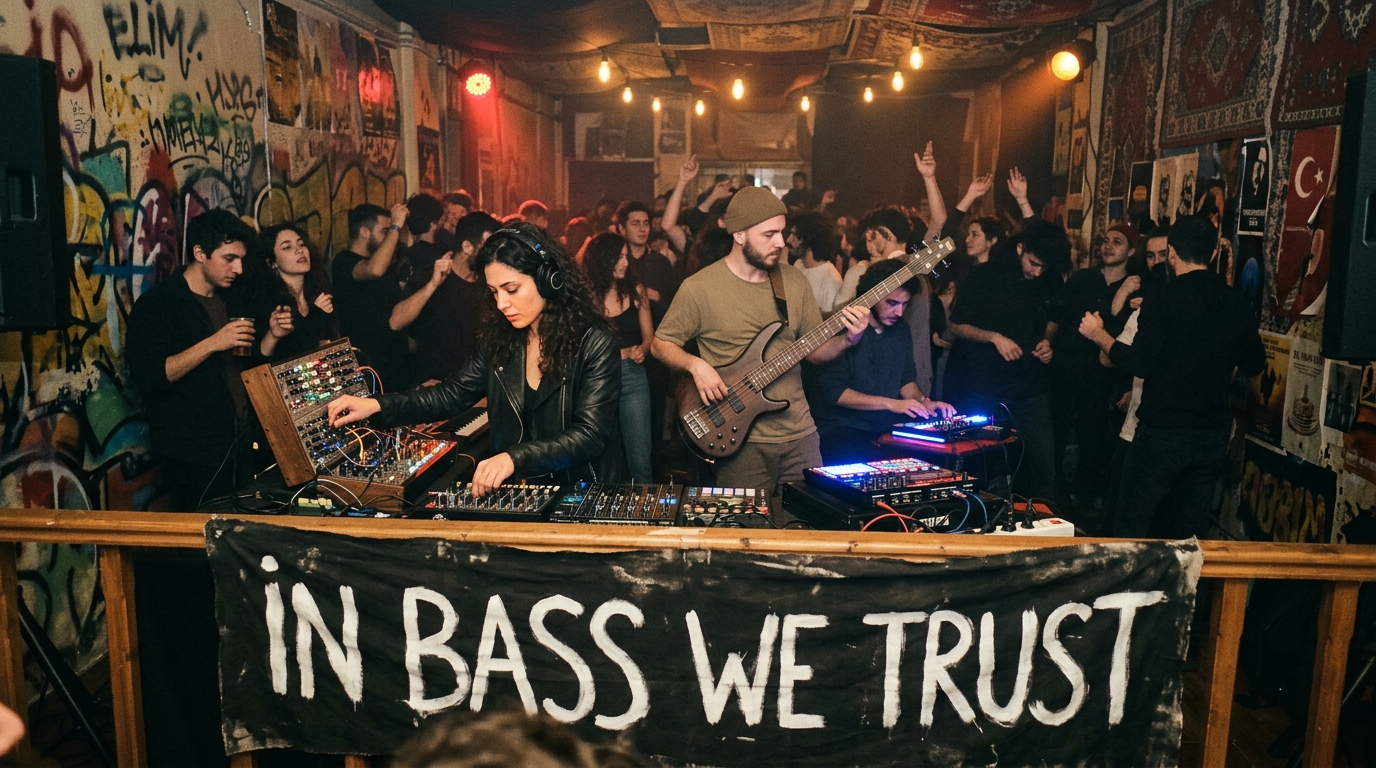
Istanbul has always been a city that absorbs sound from every direction. Centuries of overlapping musical traditions, a geographic position straddling two continents, and a restless young population have made it fertile ground for underground electronic music. Now, a bass-driven collective called IN BASS WE TRUST is pulling those threads together into something the Western press has completely missed. This is the Istanbul underground electronic music bass collective that deserves attention before the rest of the world catches up.
Exploring Istanbul’s Underground Bass Scene
The underground bass scene in Istanbul is defined by its independence, its refusal to chase trends imported from Berlin or London, and its commitment to low-end frequencies as a unifying principle. IN BASS WE TRUST, listed on Resident Advisor as an independent collective established in 2025 and based in Turkey, describes itself as focused on bass-driven electronic music and underground culture. That founding year matters: this is a scene still in its raw formation stage, which gives it an energy that more established circuits lost years ago.
What separates the Istanbul bass scene from other regional movements is its refusal to be a satellite of any single genre. You hear dubstep weight next to grime-inflected percussion next to something that could only come from a city where the call to prayer and a 140 BPM halftime riddim coexist within the same block. The music is not polished for export. It is built for the rooms it fills.
What defines the bass collective culture?
Bass collective culture in Istanbul runs on a DIY ethos closer to early UK sound system culture than to the slick promoter model dominating most European cities. The emphasis is on community-run events, shared resources, and a deliberately anti-commercial stance. I’ve seen this model work in cities like Bristol and Tbilisi, and the pattern is the same: when the money isn’t there, the music gets more honest. IN BASS WE TRUST operates as both a label and event platform, which means the people booking the nights are the same people making the records.
How has the scene evolved recently?
The evolution of the bass scene in Istanbul accelerated sharply after 2023, when a younger generation of producers began rejecting the melodic techno wave that had dominated Turkish club bookings. By 2025, IN BASS WE TRUST had formalized what had been a loose network into a proper collective with a label identity. Istanbul’s broader electronic music community, including acts like Istanbul Ghetto Club (who have appeared at MUTEK Montréal), proved that Turkish artists could hold international stages. That visibility gave local bass producers permission to think bigger without leaving home.
Key Players in the Bass Collective
The Istanbul bass collective artists driving this movement are producers and DJs who operate almost entirely outside Western media visibility. There is no Boiler Room set to point to, no Pitchfork feature, no algorithmic playlist placement. Their audience is built night by night, in rooms that hold fewer than 300 people, through word of mouth and encrypted group chats. That invisibility is precisely what keeps the sound uncompromised.
Collaborations within the collective blur the line between individual releases and group identity, similar to how EXHALE Records built its artist-first model in the techno world. The difference is scale: IN BASS WE TRUST is still small enough that every member knows every other member’s production quirks.
Who are the leading artists in 2026?
Naming leading bass artists in a scene this young requires caution, because the roster is still forming. What can be said is that the collective’s output leans toward producers who work across tempos, comfortable at 70 BPM half-time as they are at 140. The production aesthetic favors heavy sub-bass, sparse arrangements, and a rawness that rejects the over-compressed loudness war plaguing mainstream electronic music. These are not bedroom producers imitating UK grime; they are building something that sounds distinctly like Istanbul’s Asian side at 3 a.m.
What roles do DJs and producers play?
The roles of DJs and producers in this scene overlap almost completely. Most of the collective’s DJs produce their own material, and most producers DJ their own nights. This collapses the distance between creation and presentation in a way that larger scenes cannot replicate. A track gets made on Tuesday, tested on Saturday, revised on Monday. The feedback loop is immediate and physical, not mediated by streaming data or playlist curators. That tight cycle is why the sound moves fast, and it mirrors what I’ve watched happen in Tokyo’s footwork circles, where the same compression of roles produces rapid sonic evolution.
Venues Shaping Istanbul’s Bass Experience
Istanbul bass music venues operate in a city of 15 million people where nightlife infrastructure is extensive but underground electronic music occupies a specific, sometimes precarious niche. The best bass nights happen in neighborhoods like Kadıköy on the Asian side and Karaköy on the European side, areas where Istanbul’s nightlife concentrates alongside more mainstream options. The underground venues are smaller, darker, and deliberately harder to find.
Sound system quality matters more in bass music than in almost any other electronic genre. A weak sub and the whole thing falls apart. The venues that host IN BASS WE TRUST events prioritize low-end clarity over capacity, which means converted warehouse spaces and basement rooms rather than established clubs with bottle service and tourist traffic.
What are the top underground venues?
The top underground venues for bass in Istanbul shift frequently, partly because of licensing pressures and partly because the collective prefers to rotate locations to keep the experience unpredictable. Pop-up events in industrial spaces on the Kadıköy waterfront have become a signature format. These are not permanent clubs with fixed lineups; they are temporary autonomous zones where the sound system is the star and the room is secondary. That impermanence keeps the energy high and the crowd committed.
How do venues influence the scene?
The influence of venues on Istanbul’s bass scene is structural, not just atmospheric. Because most spaces are not purpose-built clubs, producers tune their sets to the specific acoustics of each room. I’ve watched DJs adjust their entire selection based on ceiling height and wall material, something that simply does not happen in a standardized festival tent. This forces a level of sonic awareness that makes Istanbul bass sets feel site-specific, almost architectural. The room shapes the music as much as the music fills the room, and that reciprocal relationship is something Beirut’s B018 understood decades ago in its own way.
Cultural Impact of Bass Music in Istanbul
The cultural impact of bass music in Istanbul extends beyond the dancefloor into questions of identity, resistance, and creative autonomy. In a city where mainstream culture often pulls toward pop and arabesque traditions, choosing to build a bass-driven underground is a deliberate act of positioning. It says something about who these artists want to be and who they refuse to become. The collective is not anti-Turkish; it is pro-specificity, insisting that Istanbul’s sound should be defined by the people living there, not by what Berlin or London expects Turkish electronic music to sound like.
This is a scene building its own infrastructure from scratch: its own label, its own nights, its own visual identity. That self-sufficiency is the most culturally significant thing about it, because it means the music does not need external validation to survive.
How does bass music reflect local culture?
Bass music and culture in Istanbul intersect at the level of rhythm and social function. The city’s musical DNA includes Ottoman classical traditions, Anatolian folk, and decades of Turkish pop, all of which carry complex rhythmic signatures that do not map neatly onto four-on-the-floor patterns. Bass music, with its emphasis on syncopation, half-time feels, and polyrhythmic layering, absorbs those influences more naturally than techno or house ever could. The result is a sound that feels rooted even when it is pushing into unfamiliar territory.
What role does community play in the scene?
The community role in the bass scene is everything, because without institutional support or commercial sponsorship, the collective runs entirely on mutual commitment. People show up not because an algorithm told them to, but because someone they trust sent a location pin at 11 p.m. That trust network is the real infrastructure. It is fragile, it is small, and it is the reason the music stays honest. Scenes like this either grow into something the world notices or they burn bright and disappear. Right now, IN BASS WE TRUST is still burning, and nobody outside Istanbul is paying attention. That will change.