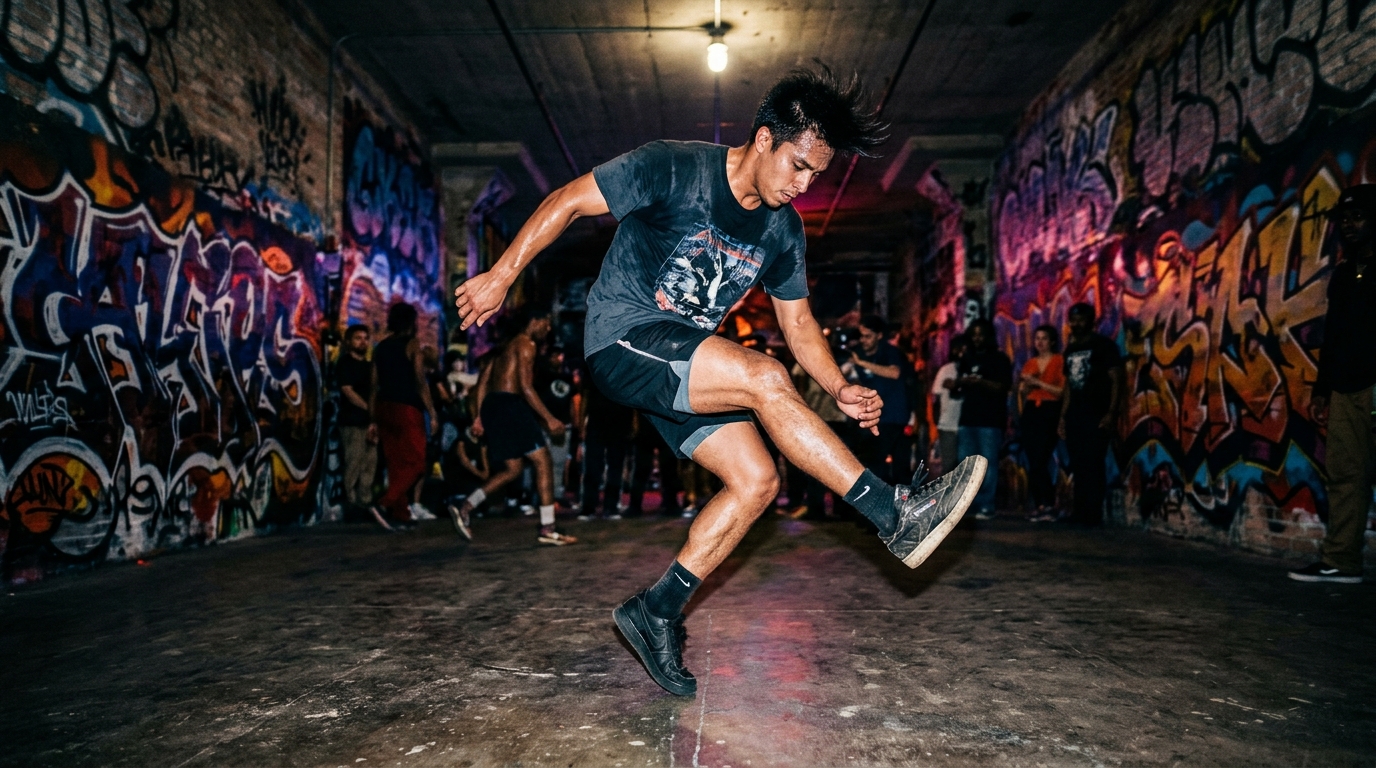
Two of electronic music’s most rhythmically volatile traditions are colliding in a way that feels less like a trend and more like an inevitability. The footwork jungle hybrid genre takes the triplet-driven velocity of Chicago’s South Side and threads it through the chopped breakbeat DNA of early-’90s London, producing something that hits harder than either source on its own. It is fast, physical, and built for rooms where standing still is not an option.
Understanding the Roots of Footwork and Jungle
Footwork originated on Chicago’s South Side in the late 1990s as an offshoot of ghetto house, locked to a near-constant 160 BPM, while jungle emerged from the UK rave scene in the early 1990s, driven by sped-up breakbeats and heavy sub-bass. Both genres were born in marginalized communities, shaped by dancers as much as producers, and built on the principle that rhythm is the message. As Telekom Electronic Beats documented, footwork’s history reveals a symbiotic relationship between dancers and DJs that mirrors jungle’s own MC-and-selector feedback loop.
Understanding footwork jungle origins means recognizing that these two scenes, separated by an ocean, developed parallel solutions to the same problem: how to make electronic music that demands physical response. Chicago had the battle circles. London had the raves. The rhythmic language they invented, independently, turned out to be surprisingly compatible.
What defines footwork music?
Footwork music characteristics center on its fixed 160 BPM tempo, triplet clave patterns, aggressive syncopation, and relentless vocal sample chops looped dozens of times per track. The genre inherited what one detailed breakdown describes as “drum & bass gymnastics inherited from jungle,” replacing the four-on-the-floor kick of house with irregularly placed hits designed to fuel competitive dance battles. Producers like Traxman reportedly sparked the 160 BPM standard by spinning ghetto house records at 45 RPM instead of 33.
How did jungle music originate?
Jungle music origins trace back to the UK rave scene of 1991 to 1994, where producers in London, Bristol, and the Midlands began time-stretching Amen breaks and layering them over deep, rolling sub-bass. The genre pulled from reggae sound system culture, early hardcore rave, and hip-hop sampling techniques. Where footwork was born in gymnasium battle circles, jungle was born on pirate radio and in warehouses, and its jungle music roots remain inseparable from that specific era of British sound system culture.
The Fusion of Footwork and Jungle Elements
Footwork and jungle fuse through their shared obsession with complex, syncopated drum programming and sub-bass weight. Both genres operate in the 150 to 170 BPM range, making tempo alignment almost effortless, and both prioritize rhythmic density over melodic sweetness. The footwork jungle fusion works because the genres share structural DNA: chopped samples, polyrhythmic layering, and an emphasis on physical movement over passive listening.
Events like those at 24 Kitchen Street in Liverpool, where Samurai Breaks brought 160 BPM+ cuts to the floor, show how this fusion is already being programmed in club contexts. The sound compatibility is not theoretical; it is being tested on real systems, in real rooms, and the floors respond.
What are the commonalities between genres?
The common elements between footwork and jungle start with tempo. Both sit comfortably around 160 BPM. Both rely on breakbeat manipulation rather than straight kick patterns. Both use sample chopping as a primary compositional tool. And both treat the low end as architecture, not decoration. I’ve heard sets where a DJ moved from a jungle refix into a footwork track without touching the pitch fader, and nobody on the floor blinked. The genres share enough rhythmic vocabulary that the transition feels native.
How do artists blend these styles?
Artists blending footwork and jungle typically start with a jungle breakbeat foundation, then overlay footwork’s triplet percussion and vocal sample loops on top. The result keeps jungle’s rolling momentum but adds footwork’s staccato unpredictability. Some producers work the other way, taking a footwork template and introducing Amen break chops and reese bass to thicken the low end. The approach matters less than the outcome: tracks that feel like they belong to both traditions and neither, simultaneously. For a parallel example of how Tokyo’s footwork scene intersects with techno, the cross-pollination follows a similar logic of shared tempo and rhythmic affinity.
Key Artists Shaping the Hybrid Genre
The footwork jungle artists pushing this sound forward span Chicago, London, and increasingly Tokyo and Berlin. DJ Rashad, before his death in 2014, was the most visible figure bridging footwork’s Chicago roots with jungle’s breakbeat sensibility, and his influence remains the single biggest gravitational force on the hybrid. Om Unit (Jim Coles) in Bristol has been equally critical, explicitly framing his productions as a conversation between jungle’s UK lineage and footwork’s American energy.
Machinedrum (Travis Stewart) brought a more polished production framework to the intersection, pulling footwork’s rhythmic ideas into wider electronic contexts. These are not niche figures. Their work has shaped how an entire generation of producers understands the relationship between breakbeats and triplet patterns, and the genre influencers working today are building directly on that foundation.
Who are the pioneers of this sound?
The pioneers of footwork jungle include DJ Rashad, whose Teklife crew made Chicago’s 160 BPM template globally legible, and Om Unit, whose label Cosmic Bridge became a home for productions that sat between jungle and footwork without apology. RP Boo, often credited as footwork’s originator, laid the rhythmic groundwork that made the fusion possible. I watched a room in East London lose its mind to an RP Boo track segueing into an old Remarc jungle cut; the energy was continuous, not collaged. That continuity is the proof the hybrid works.
What new artists are emerging?
Emerging footwork jungle artists include producers like Samurai Breaks, who programs sets at 160 BPM and above with a deliberate mix of jungle breaks and footwork percussion. Jana Rush, working from Chicago, pushes footwork into darker, more experimental territory that overlaps with jungle’s intensity. Across the Atlantic, labels releasing music in this intersection are growing. The pipeline from underground beat scenes into this hybrid space is active and accelerating, with new names surfacing on Bandcamp and SoundCloud every month.
The Cultural Impact of Footwork Jungle
The cultural impact of footwork jungle extends beyond the music itself into dance, community organizing, and how underground scenes communicate across borders. This hybrid has revitalized interest in competitive dance formats, connecting Chicago’s battle circle tradition with the UK’s rave culture in a way that neither scene managed alone. The footwork jungle culture is fundamentally participatory; it demands bodies in motion, not just ears.
Festivals like Movement Detroit have begun programming artists who sit in this crossover space, recognizing that the audience for rhythmically complex, high-BPM dance music is growing. The genre’s cultural significance lies in its refusal to be passive. It is music that insists on physical engagement, and that insistence is reshaping how promoters think about programming fast music in club spaces. Similar energy is visible in how dub minimal bridges two distinct sonic worlds through shared structural principles.
How does this genre influence dance culture?
Footwork jungle’s dance influence is direct and measurable. The hybrid’s rhythmic complexity demands a movement vocabulary that borrows from footwork’s rapid-fire legwork and jungle’s head-nodding, bass-riding sway. Dance crews in Chicago and London are increasingly sharing techniques through social media, creating a transatlantic exchange that did not exist a decade ago. The music does not allow passive consumption; it physically reorganizes the room.
What role does community play?
Community in footwork jungle is not supplementary; it is structural. Local events, Bandcamp circles, Discord servers, and crew affiliations like Teklife function as both distribution networks and quality filters. Without institutional support from major labels, the scene relies on direct community investment. Producers share stems, dancers film battles, and DJs cross-promote across cities. This grassroots infrastructure is what keeps the sound honest and prevents it from being diluted into a marketing category.
Future Trends in the Footwork Jungle Scene
The future of footwork jungle points toward deeper integration with experimental electronic music and broader festival programming. As more producers gain access to advanced sampling tools and granular synthesis, the rhythmic possibilities within the 160 BPM framework are expanding rapidly. Collaborative projects between Chicago and London producers are becoming more common, and the genre’s presence on streaming platforms, while still small, is growing steadily.
The hybrid is also attracting attention from adjacent scenes. Producers rooted in hard techno and peak-time techno are beginning to incorporate breakbeat elements that owe a clear debt to jungle, while footwork’s influence on experimental bass music continues to spread. The next phase of this genre will likely be defined by how well it maintains its physical, dance-first identity while absorbing new production techniques.
What innovations are on the horizon?
Innovations in footwork jungle are coming from two directions simultaneously. On the production side, granular synthesis and AI-assisted sample manipulation are enabling producers to chop and reassemble breaks at a level of detail that was impossible five years ago. On the performance side, hybrid DJ/dancer sets, where the person selecting tracks is also battling, are emerging as a format that honors both genres’ roots. The innovation that matters most is not technological; it is structural. The genre is building its own infrastructure outside traditional label systems.
How is technology shaping the sound?
Technology in footwork jungle is accelerating the genre’s evolution without replacing its core principles. DAWs like Ableton Live and hardware samplers from Elektron allow producers to program the kind of intricate, polyrhythmic drum patterns that define the hybrid, at a fraction of the cost and time it took in the late ’90s. Real-time audio manipulation tools let DJs reshape breaks on the fly during sets, blurring the line between production and performance. The tools are new. The impulse, making people move at 160 BPM with nothing but rhythm and bass, is as old as both genres.