There is a sound that lives between the echo and the silence, between the weight of Jamaican dub and the skeletal precision of minimal techno. The dub minimal techno subgenre occupies a space most listeners walk past without noticing, but once you hear it properly, on a good system, in a dark room at 3 a.m., it rewires how you understand space in electronic music. It is not loud. It is not fast. It is patient, and that patience is its power.
Understanding the Essence of Dub Minimal
Dub minimal is defined by its radical commitment to negative space: heavy reverb tails, tape-saturated delays, and stripped-back rhythmic frameworks that sit comfortably between 118 and 126 BPM. Where standard minimal techno relies on micro-variations in percussion, dub minimal adds a second gravitational pull through echo and sub-bass weight inherited directly from dub music’s Jamaican roots.
The genre lives on Beatport’s Minimal / Deep Tech charts in a quiet but persistent way, never dominating the top ten but always present in the deeper pages where the real heads are digging. That persistence says something about the audience: small, loyal, resistant to trend cycles.
What Defines Dub Minimal Techno?
The dub minimal definition centers on the collision of two philosophies: dub’s obsession with the mixing desk as instrument and minimal techno’s obsession with reduction. A dub minimal track treats reverb and delay not as effects but as structural elements. The echo is the melody. The space between kicks carries as much intention as the kicks themselves.
Key Characteristics of the Genre
Core dub minimal characteristics include sub-heavy bass lines that pulse rather than punch, long reverb decays that blur the boundary between foreground and background, and percussion that often sounds like it is being heard through a wall. Chord stabs, when they appear, are washed in so much delay they become ambient texture. The result is hypnotic rather than driving. I’ve played records in this style back-to-back for two hours and watched a floor stay locked in without a single build or drop.
Historical Roots of Dub Minimal Techno
The historical roots of dub minimal trace back to early 1990s Berlin, where producers began fusing King Tubby’s studio techniques with the emerging minimal techno sound coming out of Detroit and Cologne. Rhythm & Sound, the project of Mark Ernestus and Moritz von Oswald, is widely cited as a pioneering dub techno act, and their work sits at the exact intersection where dub’s warmth meets techno’s machine logic.
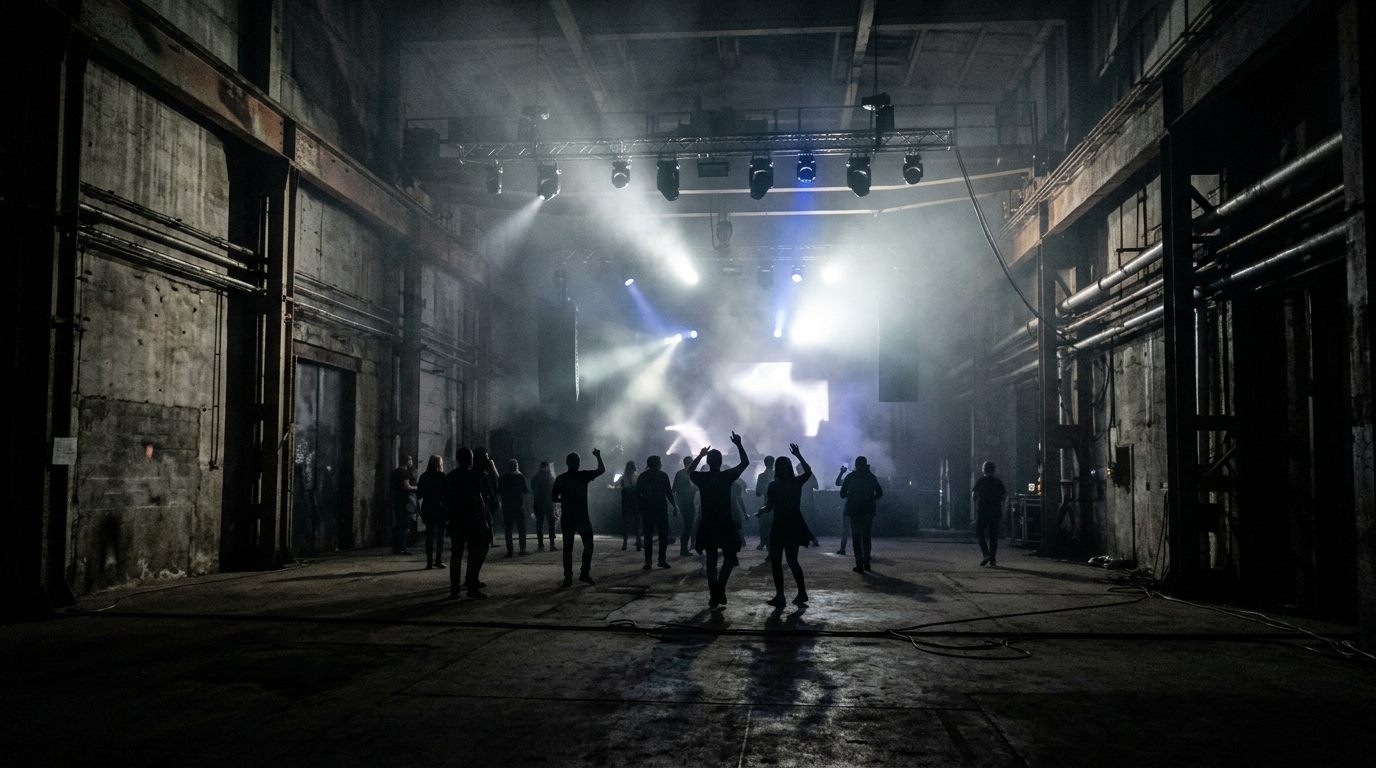
Basic Channel, the duo’s earlier project on their own label, laid the template in the mid-1990s with records that sounded like transmissions from underwater. That template proved remarkably durable. Berlin’s club infrastructure, particularly spaces like Tresor and the long nights at Bar 25, gave the sound a physical home where it could stretch across hours rather than minutes.
Origins in Dub and Minimal Techno
The dub minimal origins sit at a specific crossroads: Jamaican sound system culture’s emphasis on bass weight and studio manipulation met German techno’s reductive discipline. King Tubby and Lee “Scratch” Perry treated the mixing desk as a live instrument in the 1970s. Two decades later, Berlin producers applied that same philosophy to drum machines and digital delays, stripping away everything except rhythm and resonance. The connection was never academic; it was intuitive, felt through shared obsession with what happens inside Berlin’s longest nights.
Evolution Through the Years
The evolution of dub minimal moved through distinct phases. The mid-1990s Basic Channel era established the blueprint. The early 2000s saw Ricardo Villalobos and others fold dub elements into the Romanian and German minimal scenes, stretching tracks past the ten-minute mark and introducing micro-house clicks alongside cavernous delays. By the 2010s, the sound had become a quiet undercurrent rather than a visible movement, absorbed into broader melodic techno and deep listening contexts. That absorption did not kill it. It made it harder to find and more rewarding when you did.
Key Artists Shaping Dub Minimal Today
The most influential dub minimal artists share a common trait: patience in the studio and a refusal to chase peak-time energy. Ricardo Villalobos remains the most visible name associated with the sound, though his output sprawls across many styles. Rhadoo, Raresh, and the broader [a:rpia:r] circle in Bucharest have kept the minimal-dub intersection alive through marathon DJ sets where echo and space do the heavy lifting.
Beyond the established names, the scene sustains itself through small labels and Bandcamp pages that rarely break 500 followers. That is not a failure; it is the genre’s immune system. I watched Rhadoo hold a room at Sunwaves for close to five hours once, and the dub-inflected passages were the moments where the crowd went deepest, eyes closed, weight shifting slowly.
Influential Producers and DJs
Key dub minimal producers include Ernestus and von Oswald (through both Basic Channel and Rhythm & Sound), Villalobos, Luciano, and Zip, all of whom have used dub’s spatial vocabulary within minimal frameworks. Richie Hawtin’s early Plastikman work touched similar territory from a different angle, prioritizing acid-laced reduction with dub-style mixing desk manipulation. Detroit’s ongoing connection to Tresor keeps the transatlantic thread alive.
Emerging Talents in the Scene
Emerging dub minimal artists are harder to name precisely because the genre rewards anonymity. White-label 12-inches with no social media presence still circulate in this corner. What connects the newer producers is a shared toolkit: long reverb chains, tape saturation, and a willingness to let a track breathe for eight minutes before introducing a second element. The Quietus’s recent electronic music coverage highlights how hyperspecific subgenres like this continue to generate fresh output even without mainstream visibility.
The Sound and Production Techniques
Dub minimal production techniques revolve around the creative abuse of delay and reverb as compositional tools rather than mix sweeteners. A typical session starts with a sparse percussion loop, often just a kick and a single percussive hit, then builds outward through layers of send effects. Ableton Live is the dominant DAW in this space, with producers using its return tracks to create feedback delay networks that generate evolving textures from minimal input.
The approach is closer to dub’s original studio methodology than most modern electronic production. Dub techno templates for Ableton circulate widely, but the best producers treat those as starting points, not destinations. The real craft is in knowing when to pull a channel down and let the echo speak alone.
Common Tools and Equipment Used
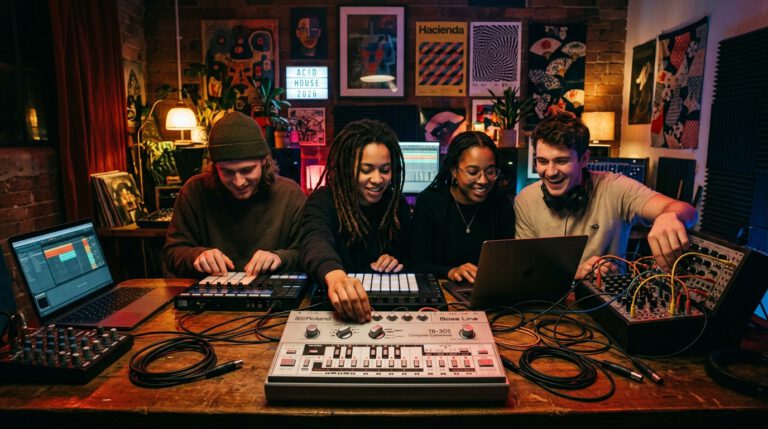
Dub minimal tools lean heavily on software delays and spring reverb emulations, though hardware units like the Roland RE-201 Space Echo remain aspirational references. Producers frequently use Ableton Live’s built-in delay and reverb racks, Valhalla plugins for lush algorithmic spaces, and analog-modeled compressors to glue the sparse elements together. A Behringer audio interface and a simple MIDI controller are enough to start; the genre’s barrier to entry is taste, not budget.
Production Techniques Unique to Dub Minimal
The unique dub minimal techniques center on feedback routing: sending a delay’s output back into itself with subtle filtering on each pass, creating decaying harmonic trails that evolve unpredictably. Sidechain compression keyed to the kick drum is used not for the pumping effect common in house music but to create rhythmic breathing in the reverb tails. High-pass filtering on delays ensures the sub-bass stays clean while the midrange dissolves into fog. It is a subtractive art. You build by removing.
Cultural Impact and Community of Dub Minimal
The cultural impact of dub minimal extends well beyond its small audience numbers. As Wikipedia’s techno entry documents, dub techno is recognized as a distinct subgenre alongside Detroit techno, acid techno, and industrial techno. Dub minimal sits at the intersection of that dub techno lineage and the minimal techno branch, influencing how producers across the broader electronic spectrum think about space, echo, and restraint.
Its fingerprints are on ambient techno, on the deeper end of progressive house, and on the underground beats that rarely surface in algorithmic playlists. The community is small but geographically scattered: Berlin, Bucharest, Tokyo, São Paulo, each city hosting a handful of DJs and promoters who keep the sound in rotation.
How Dub Minimal Influences Other Genres
Dub minimal genre influence shows up most clearly in the way contemporary melodic techno producers use reverb. The long, washed-out pads that define artists like Stephan Bodzin or Recondite owe a direct debt to the spatial thinking that dub minimal pioneered. Even hard techno producers borrow the sidechain-to-reverb technique when they want a moment of tension before a drop. The influence is structural, not stylistic: it taught electronic music that emptiness is an active choice, not a gap to fill.
The Global Dub Minimal Community
The dub minimal community operates largely through word of mouth, small-run vinyl pressings, and niche online forums. Events dedicated purely to the sound are rare, but dedicated rooms at festivals like Sunwaves or Dekmantel’s deeper stages consistently program it. There is no central institution, no flagship label with a marketing budget. That absence is the point. The community self-selects for listeners who prefer immersion over spectacle, and that filter keeps the music honest.