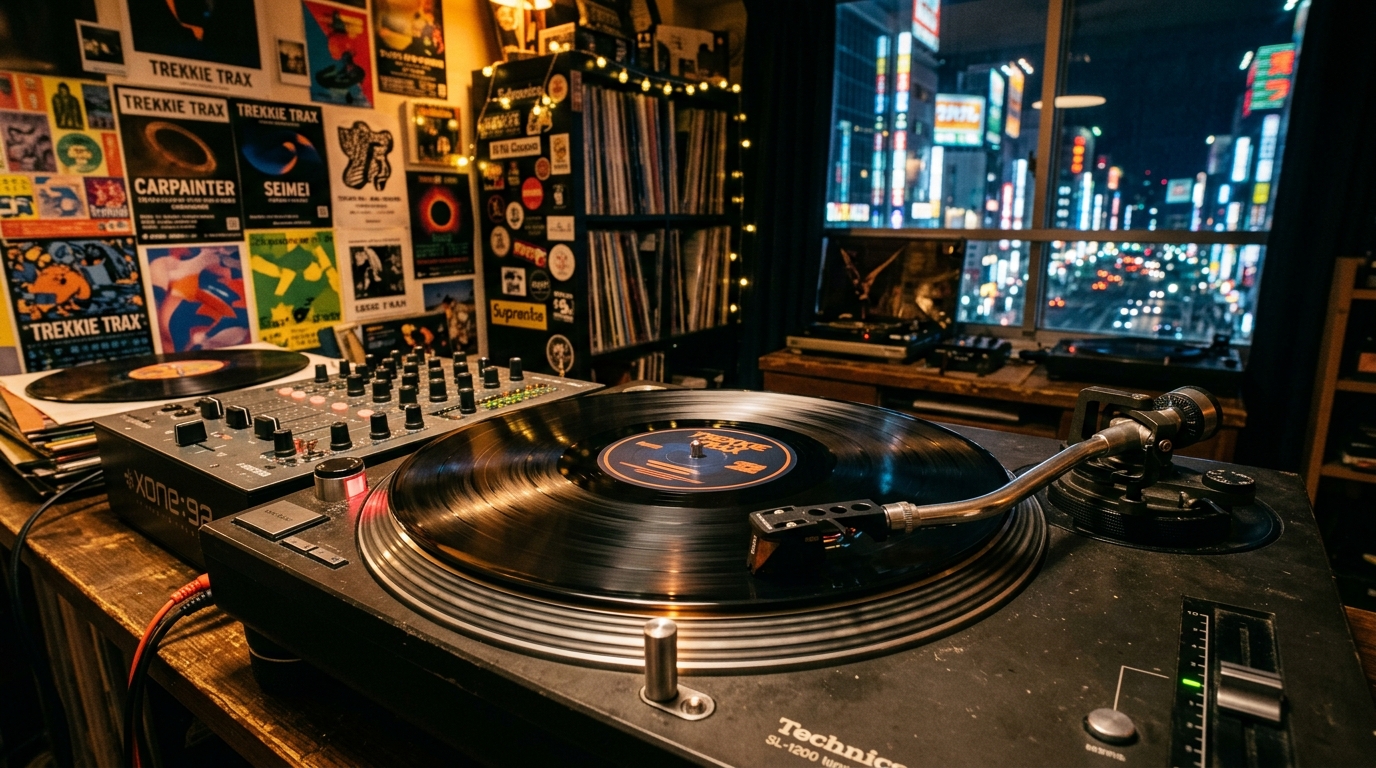
Most conversations about Japanese electronic music stall at the same three or four names. Trekkie Trax rarely appears in those conversations outside Japan, which is exactly the problem. Active since 2012 and approaching its 15th anniversary in 2027, this Tokyo-born collective has quietly built one of the most genre-fluid catalogs in underground electronic music. The Trekkie Trax label Japan electronic music scene at its least predictable: footwork sitting next to dubstep, jungle bleeding into techno, hip-hop production ideas smuggled into club tracks that hit at 160 BPM. If you care about where club music is actually going rather than where algorithms say it’s been, this is the label to watch.
Understanding Trekkie Trax’s Unique Identity
Trekkie Trax’s identity is defined by a refusal to commit to a single genre, functioning instead as a crew-driven collective where footwork, jungle, dubstep, techno, and hip-hop coexist on the same release schedule. That open-genre philosophy, rare for any label but almost unheard of in Tokyo’s often compartmentalized underground music scene, is what separates it from peers.
The label emerged from a generation of Tokyo producers raised equally on Chicago juke edits and Japanese net-label culture. Where a European imprint might brand itself around a tempo range or a specific room, Trekkie Trax branded itself around a social circle. The crew ethos matters more than any sonic signature, and that distinction has kept the music culture around the label alive for over a decade.
What Makes Trekkie Trax Stand Out?
The standout feature is range. A single quarter on the label’s Bandcamp page might include a footwork album, a bass-heavy EP, and a collaborative remix package featuring international producers like umru alongside Japanese artists. Most innovative labels narrow their focus as they age. Trekkie Trax has done the opposite, widening its aperture with every year, which keeps the roster unpredictable and the audience genuinely curious about what drops next.
Key Artists and Their Contributions
Oyubi is the name to know right now. A Tokyo-based footwork producer and dancer with roots in the Battle Train Tokyo competition circuit, he’s releasing his debut album White birch burns on Trekkie Trax in June 2026: 12 tracks spanning footwork, jungle, hip-hop, dubstep, and techno. Masayoshi Iimori, a longtime Trekkie Trax artist, dropped his Feelin’ Down EP in April 2026. Guchon, Hizuo, TIMER, and Pura Pura have all released EPs through the label in 2026 alone. The depth of the roster is the point; no single artist defines the label because the collective itself is the artist.
The Impact of Trekkie Trax on Japanese Music
Trekkie Trax has influenced the Japanese music scene by proving that a crew-first, genre-agnostic model can sustain a label for over a decade without major-label backing or a single viral moment. As Make Believe Melodies noted in May 2026, it’s “funny to consider TREKKIE TRAX an elder presence in the Tokyo electronic scene,” but that’s exactly what the collective has become, with a whole generation of artists emerging in its wake.
The influence runs deeper than release numbers. I’ve watched younger Tokyo producers cite Trekkie Trax nights as the first time they heard footwork played alongside four-to-the-floor club tracks in the same set. That kind of cross-pollination was not standard in Tokyo a decade ago. It is now, and the label deserves significant credit for normalizing it. Compare that to how Keinemusik built a collective identity in Berlin; the crew model works across cultures when the trust is real.
How Has It Influenced the Scene?
The Trekkie Trax influence shows up in how younger Japanese producers think about genre boundaries. Before the collective gained traction, Tokyo’s club scenes were more siloed: techno nights stayed techno, bass music stayed bass. Trekkie Trax’s events and releases made it normal to program a night where 160 BPM footwork and 130 BPM house tracks could share a bill without anyone flinching. That programming philosophy has filtered into how venues like Live Haus in Shimokitazawa book their nights today.
Notable Collaborations and Releases
The Highball Presents TREKKIE TRAX compilation, a collaboration with London’s Highball Records, is a strong recent example of the label’s international reach. It features core Trekkie Trax crew members alongside outside contributors, functioning as both a label sampler and a cross-border handshake. The Open Remixes package, released in May 2026 with contributions from umru and nextdimensional, shows the label actively pulling in voices from hyperpop and experimental bass scenes. Oyubi’s collaboration with Fetus on “Mood organ” from White birch burns extends the footwork-meets-everything approach that defines the roster. These are not prestige collaborations for press coverage; they’re working relationships between producers who share files and ideas.
Exploring Trekkie Trax’s Eclectic Sound
Trekkie Trax represents footwork, jungle, dubstep, techno, house, hip-hop, and experimental bass, often within a single release. The label’s sound is not a genre; it’s a disposition toward genre itself. Where most electronic sub-genres define themselves by tempo and texture, the Trekkie Trax sound is defined by the willingness to collapse those categories entirely.
That eclecticism is what makes the catalog so useful for DJs who play across tempos. I’ve pulled Masayoshi Iimori tracks into sets that were otherwise running at 128 and the energy shift worked precisely because the production quality holds at any speed. The diversity of the music on this label is not a branding exercise; it reflects how the producers actually listen.
What Genres Are Represented?
The Trekkie Trax catalog spans footwork (Oyubi, Guchon), bass music and dubstep (TIMER’s Sea Wolf EP), experimental electronic sounds (Hizuo’s ALS PT19 EP), and club-ready house and techno hybrids. The label also touches hip-hop production and, through collaborations with artists like umru, brushes against hyperpop and deconstructed club music. If you’re interested in how Tokyo footwork intersects with techno, Trekkie Trax is the primary source text.
How Does It Reflect Japanese Culture?
Oyubi’s White birch burns is the clearest example of Trekkie Trax reflecting Japanese culture through electronic music. The album title references okuribi, a ritual from the Obon festival observed in Komade-ike, Nagano prefecture, where white birch branches are burned to send off the spirits of the dead. The album processes childhood memories and grief through footwork rhythms. That kind of cultural specificity, spiritual Japanese traditions filtered through Chicago-rooted dance music, is something no other label is doing at this level. It is not exoticism; it is autobiography.
The Future of Trekkie Trax and Electronic Music
The future of Trekkie Trax points toward deeper international partnerships and a continued expansion of its genre palette, with the label approaching its 15th anniversary in 2027. The collective has already proven it can outlast trends; the question now is whether it can scale its model without losing the crew intimacy that makes it work.
Other regional scenes face similar scaling questions. China’s techno underground is navigating comparable tensions between local identity and global reach. Trekkie Trax has a head start: the Bandcamp catalog is deep, the international collaborations are already in motion, and the roster keeps refreshing itself with new producers who grew up on the label’s output.
What Are Upcoming Projects?
Oyubi’s White birch burns, the 12-track debut album dropping June 24, 2026, is the label’s biggest upcoming project. He’ll celebrate the release with an open-to-close set at Live Haus in Shimokitazawa, Tokyo on July 11th. Beyond that, the label’s 2026 release pace has been aggressive: EPs from TIMER, Hizuo, Pura Pura, Guchon, and Masayoshi Iimori have all landed in the first five months of the year. That cadence suggests more is coming, and the Highball Records collaboration hints at further UK-Japan crossover releases.
How Is It Adapting to Trends?
Trekkie Trax adapts to trends by absorbing them rather than chasing them. The inclusion of umru on the Open Remixes package reflects an awareness of hyperpop and deconstructed club’s growing influence without pivoting the entire label toward it. The footwork core remains, but the edges keep shifting. That strategy is smarter than trend-hopping because it keeps the catalog coherent while staying current. I’ve seen labels twice Trekkie Trax’s size collapse by chasing a single sound; this crew survives because it was never about one sound to begin with.