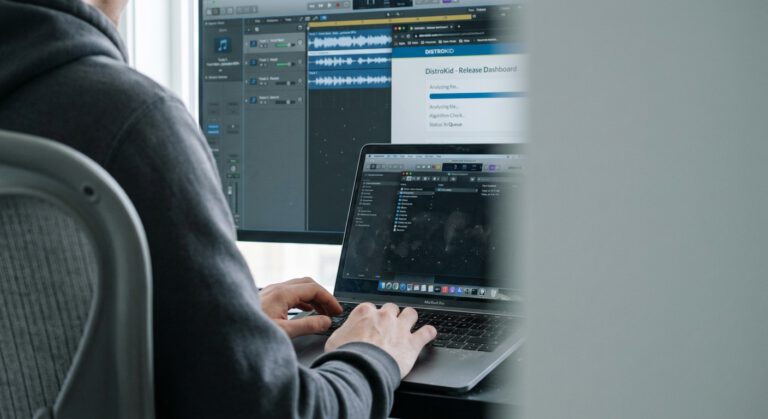
The argument over AI curation vs human curation electronic music keeps surfacing in green rooms, label group chats, and late-night threads. Algorithms can parse millions of tracks in seconds. A seasoned selector can read a room in one glance. Both claim to surface the best underground techno, but they operate on fundamentally different logic. One optimizes for patterns; the other trusts instinct shaped by years on dancefloors. The real question is which method actually puts the right record in front of the right listener at the right moment.
Understanding AI Curation in Electronic Music
AI curation in electronic music uses machine learning models to analyze listener behavior, audio features, and metadata, then generates playlist recommendations tuned to individual taste profiles. Platforms like Spotify’s Discover Weekly process over 100 million tracks using collaborative filtering and natural language processing to match users with new releases. In May 2026, diggercamp launched an AI-powered discovery platform specifically targeting underground electronic music, signaling that even niche scenes are now algorithm-addressable.
The technology works best at scale. For a listener who consumes 30 hours of techno a week across multiple sub-styles, AI can identify micro-preferences, like a pull toward reverb-heavy percussion or kick drums tuned around 135 BPM, that the listener might not consciously recognize. Labels like Fachwerk Records in Berlin already see algorithmic playlists driving a measurable share of their catalog streams.
How Does AI Analyze Music Preferences?
AI music analysis starts with two data layers: behavioral signals (skip rates, repeat plays, save actions) and acoustic fingerprinting (tempo, key, spectral density, rhythmic complexity). Collaborative filtering then cross-references your listening against millions of similar profiles. If you play Dax J back-to-back with Rebekah, the system infers a preference for hard, industrial-leaning techno around 138 BPM and surfaces adjacent artists you haven’t encountered.
What Algorithms Power AI Music Curation?
Most major platforms rely on a hybrid stack: collaborative filtering for social pattern matching, convolutional neural networks for raw audio classification, and natural language processing that scrapes blog reviews, forum posts, and social tags to build genre context. Spotify’s AI music algorithms combine all three. The weakness is that these models optimize for engagement metrics, not cultural significance, which means a track that keeps you streaming is ranked above a track that might genuinely challenge your ear.
The Role of Human Curation in Music Discovery
Human curation brings cultural context, emotional intelligence, and scene knowledge that no data model replicates. A human curator doesn’t just hear a track; they understand why a particular release matters at a particular moment, who made it, what it responds to, and where it belongs in a set. That contextual layer is what separates a playlist from a statement.
I’ve watched a DJ at Tresor pull a record from 2003, a deep cut nobody in the room expected, and shift the entire energy of a Saturday night. No algorithm would have recommended that track based on the crowd’s recent listening data. The choice came from reading bodies, sensing fatigue, and knowing that sometimes the floor needs a left turn more than a logical next step. That kind of music discovery still lives exclusively in human hands.
What Makes Human Curators Unique?
What makes unique human curators irreplaceable is their ability to weigh intangibles: political context, scene politics, the emotional arc of a night, a personal relationship with a producer whose work they’ve followed since a first white label. Curators at outlets like Resident Advisor or Dekmantel’s programming team don’t just select good tracks; they construct narratives. An algorithm sees data points. A curator sees a story.
How Do Humans Discover Underground Tracks?
Underground music reaches human ears through trust networks: label mailing lists, Bandcamp deep dives, tips from other DJs, record shop staff recommendations, and late nights on SoundCloud following reposts from artists they respect. I found some of my most-played records through a single Bandcamp tag rabbit hole that started with Spazio Disponibile’s hypnotic techno catalog and ended three hours later on a self-released EP from a producer in Tbilisi with 40 followers. No recommendation engine would have built that path.
Comparing Effectiveness: AI vs Human
For sheer volume and speed, AI wins the effectiveness comparison. It can surface 50 relevant tracks in the time a human curator auditions one. But relevance measured by acoustic similarity is not the same as relevance measured by cultural weight. A 2026 study on algorithmic curation effects on Spotify showed that heavy algorithm reliance narrows listener taste over time, creating feedback loops that reinforce existing preferences rather than expanding them.
Human curation is slower, more expensive, and harder to scale. It is also the only method that consistently surfaces records with no prior streaming data, no metadata optimization, and no playlist-ready packaging. The producers shaping scenes in cities like Bangkok’s No Signal Techno events or Berlin’s warehouse circuit often release music that algorithms simply cannot find because it doesn’t exist in indexed databases yet.
Who Curates More Diverse Selections?
Human curators build more genuinely diverse music selections because they actively seek discomfort. A good selector programs tension: a 126 BPM deep house track followed by a 140 BPM industrial cut, or an Afro-influenced groove dropped into a minimal set. Algorithms optimize for coherence, which often means homogeneity. Spotify’s own internal research has acknowledged that algorithmic playlists cluster around familiar sonic profiles, reducing exposure to outlier genres and cross-regional sounds.
Which Method Is More Accurate?
Accuracy in music curation depends entirely on what you’re measuring. If accuracy means “predicting what a listener will not skip,” AI is more accurate by a wide margin; its skip-rate optimization is precise. If accuracy means “identifying the record that will define a scene six months from now,” humans win every time. The A&R instinct that led labels like Ostgut Ton or Hessle Audio to sign unknown artists before anyone else cared is a form of predictive accuracy that no neural network has matched.
The Future of Music Curation Techniques
The future of curation is not a binary replacement but a layered integration. AI handles the first filter: scanning thousands of new releases weekly, flagging tracks that match specific sonic parameters. Human curators handle the second filter: listening, contextualizing, and deciding what actually matters. The hybrid model is already emerging at forward-thinking labels and media platforms, and it will become standard within two to three years across the music industry.
At the 2026 International Music Summit in Ibiza, panelists emphasized that AI will not replace human emotional judgment in electronic music. The consensus among working professionals was clear: technology should reduce the labor of discovery, not replace the taste that gives discovery meaning.
How Will AI Evolve in Music Curation?
AI evolution in curation will likely focus on emotional recognition and contextual awareness. Future models may analyze not just what a track sounds like but when and where it’s being played, adjusting recommendations for time of day, venue size, or even crowd density. The gap between AI and human judgment will shrink on the technical side. But the cultural gap, knowing why a record from Berlin’s raw industrial techno wave matters right now, will remain human territory for the foreseeable future.
What Trends Are Emerging in Human Curation?
Emerging trends in curation show human selectors increasingly using AI as a research assistant rather than a replacement. Curators at independent labels and radio shows use algorithmic tools to scan new uploads, then apply their own filters. The role is shifting from pure gatekeeping to informed editing. The curators who thrive will be the ones who treat AI as a shovel and their own ears as the compass, moving faster without losing the instinct that makes their selections worth following.