Berlin’s club scene is contracting. Not collapsing, not dying, but reshaping itself around a structural truth that the tourist-era model papered over for years: when the cheap flights thin out and the weekend ravers stop coming, the venues built on volume are the first to feel it. The Berlin club scene tourism decline 2026 is not a single event but a slow correction, and the formats surviving it look nothing like the ones struggling. This is a story about which rooms still fill and why.
How Far Has Berlin Tourism Actually Fallen
Berlin tourism declined roughly 4% year-on-year in 2025, recording 29.4 million overnight stays from 12.4 million visitors, down from 30.6 million and 12.7 million the year prior. Excluding the Covid-19 anomaly, this marks the city’s first tourism dip in over a decade. The drop is modest in raw numbers but structurally significant for nightlife, where weekend visitor volume directly underwrites door revenue.
Rising accommodation costs, reduced low-cost carrier routes, and geopolitical instability have all compressed the pipeline. The “easyJet set” that cultural journalist Tobias Rapp identified in the 2000s, weekend ravers flying in from London, Madrid, Stockholm, is no longer arriving at the same rate. According to Visit Berlin, roughly 22% of international visitors and 17% of domestic tourists still cite clubbing as a reason for their trip, but those visitors increasingly overlap with Berlin’s growing international workforce rather than the 48-hour party tourist.
Which Visitor Segments Dropped Most Sharply
Young European short-stay visitors, the core of Berlin’s weekend party tourism, have shown the steepest Berlin visitor segment decline. Budget travellers who once flew in on Friday and left Sunday are being priced out by higher airfare, €20-30 club entry fees, and €5-7 beers. The demographic that once made a full night out possible for €10-20 now faces bills of €50-100.
How 2026 Numbers Compare to Pre-Pandemic Peaks
The Berlin tourism pre-pandemic comparison reveals a city that has technically recovered in total volume but shifted in composition. Pre-pandemic peaks saw a higher proportion of pure leisure visitors; the 2025-2026 figures include more business and relocation-related stays. For nightlife, the relevant metric is not total overnight stays but weekend leisure arrivals, and that specific number has not recovered to 2019 levels.
Are Budget Travelers or High-Spenders Leaving Faster
Budget tourists are leaving faster. The Berlin budget vs high-spend tourist decline is asymmetric: high-spending international visitors, often arriving for longer cultural stays, have proven more resilient. This shifts the revenue base toward premium experiences. The volume model that sustained large techno venues is eroding while niche, curated nights hold steadier.
Why Berlin Clubs Depended So Heavily on Tourist Footfall
Berlin clubs became financially dependent on tourist visitors because the city’s low cost of living, which made the scene possible, also meant locals spent less per night out. At peak years, tourists accounted for an estimated 40-60% of door revenue at major techno venues, particularly on Friday and Saturday nights. That ratio made visitor volume a critical lever for profitability, not a bonus.
The structural imbalance was always visible if you looked. I’ve stood in queues at Kreuzberg venues where German was the third or fourth language spoken. The door was a border checkpoint for an international economy, and the clubs knew it. As Original Berlin Tours documented, the cost of a night out has roughly tripled since the early 2000s, but the local wage base hasn’t kept pace. That gap was filled by tourist euros.
What Percentage of Club Revenue Came from Tourists
The Berlin club tourist revenue percentage varied by venue, but internationally branded spaces routinely drew over half their weekend door income from non-residents. Mid-week sessions skewed local, but the economics of large-capacity rooms depend on peak nights. When those peak nights lose 20-30% of their crowd, the math breaks quickly.
How Tourist Spending Differed from Local Spending Patterns
Tourist vs local nightlife spending in Berlin diverged sharply. Visitors spent more on entry, drinks, and merchandise per visit, treating a club night as a destination experience. Locals, especially the artist and student communities that built the scene, attended more frequently but at lower per-head spend. The clubs optimized for tourist peaks, not local consistency.
Which Nights and Formats Relied Most on Visitor Traffic
Friday and Saturday nights at large-capacity rooms with international headliner bookings carried the heaviest Berlin club nights tourist dependency. These formats required 800+ bodies to break even. Sunday sessions and mid-week events, where local regulars shaped the floor, were less exposed but also less profitable.
Club Formats Thriving Despite the Tourism Dip
Smaller, membership-oriented venues and culturally rooted clubs with strong local identity are the Berlin clubs surviving tourism decline most convincingly. These formats were never built on visitor volume. Their attendance models rely on community trust, repeat attendance, and programming that rewards familiarity over spectacle.
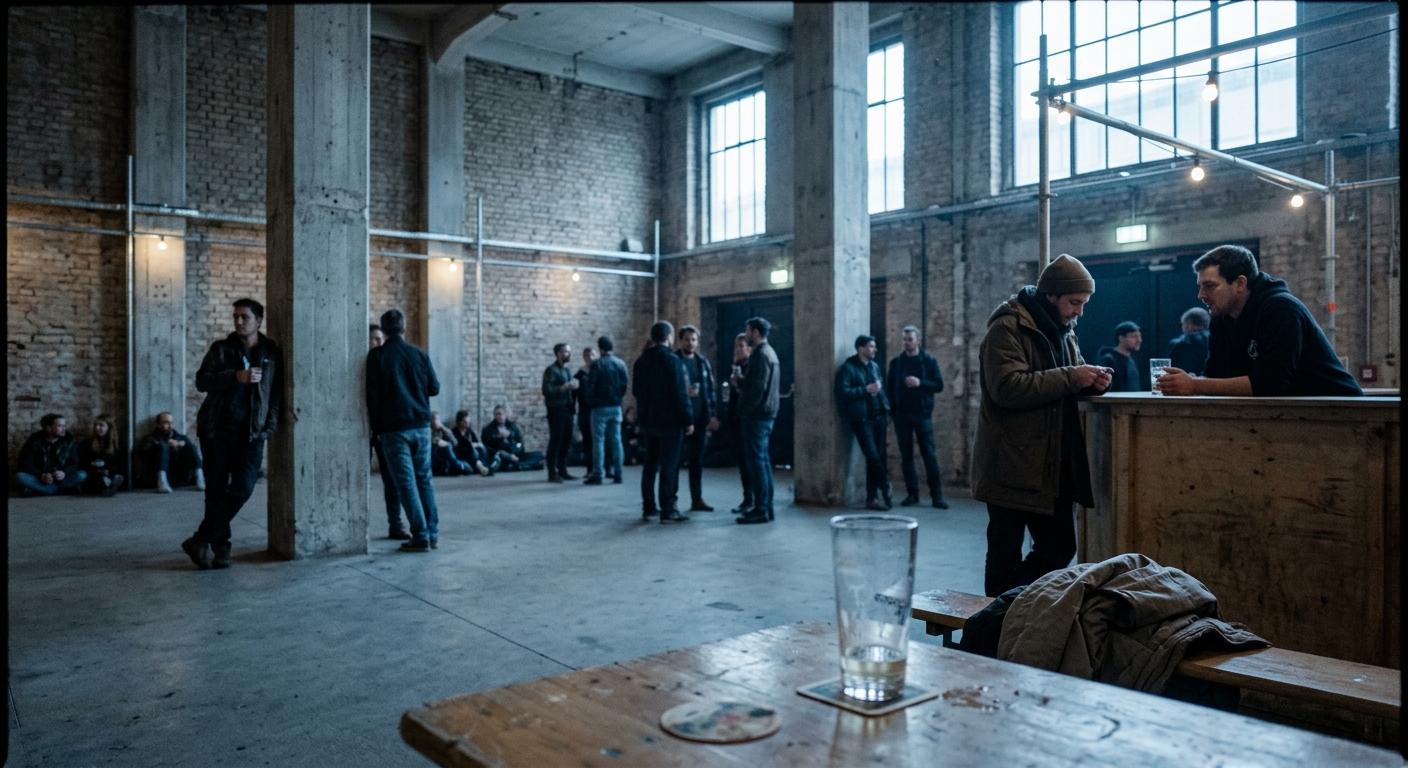
The atmosphere in some of these rooms has actually improved. I watched a Thursday night at a 200-capacity Neukölln basement last spring where every person on the floor knew the resident. No phones, no tourist confusion at the bar, no one asking what time it closes. That energy is hard to manufacture, and it is exactly what the volume-dependent venues cannot replicate.
Why Intimate Member-Model Clubs Are Outperforming
Berlin member-model club success comes down to predictable revenue and lower fixed costs. A 150-cap room with a loyal membership base can operate profitably at 70% capacity. These venues also control their crowd composition, which protects the sonic and social experience that keeps members returning. The model is inherently tourist-proof.
How Community-Led Venues Retain Local Loyalty
Berlin community club local loyalty is built through consistent programming, resident DJs who play regularly enough to develop a following, and pricing that respects local wages. Venues like these often run label nights, host local collectives, and treat their space as a cultural commons rather than a commercial product. That identity deepens during downturns rather than cracking.
Which Music Formats Attract Resilient Domestic Audiences
Berlin domestic nightlife music formats skewing toward deeper, slower, or more experimental sounds are holding steady. Deep house, dub techno, and ambient-adjacent programming draw committed local audiences who attend for the music, not the brand. The raw industrial techno wave in Berlin has also consolidated a dedicated local following that does not depend on international name recognition.
Club Formats Struggling Most in the Post-Tourist Era
Large-capacity venues with high fixed costs and brand identities built on international reputation are the Berlin clubs struggling most from the tourism drop. Their cost structures were calibrated for peak-era attendance: 1,000+ capacity rooms, international headliner fees of €5,000-15,000 per night, and staffing levels that assume full houses every weekend.
Several high-profile venues have already reduced operating nights or announced temporary closures. The pattern is clear: global fame does not protect a club when its core revenue source contracts. Operational scaling, not reputation, is the decisive survival factor now.
Why Large-Capacity Techno Venues Face Existential Pressure
Berlin large techno venue financial pressure is a fixed-cost problem. A 1,500-capacity room running at 60% attendance still pays full rent, full sound, full security. The margin disappears before the headliner even gets paid. These rooms cannot simply “go local” because the local audience was never large enough to fill them on a Saturday.
How Branded Flagship Clubs Are Losing Their Edge
Berlin flagship club brand decline is accelerating because the brand itself was the product tourists consumed. When the tourist pipeline contracts, the brand has no secondary function. Meanwhile, the door policies and pricing that once signaled exclusivity now read as hostility to the local audience these venues desperately need. The anti-commercial model Meakusma represents is the opposite of this trajectory.
What Closure Patterns Reveal About Format Vulnerability
Berlin club closure patterns 2026 show a consistent profile: venues with capacity above 800, weekend-heavy programming, and international booking rosters are the most vulnerable. Smaller rooms, multi-use spaces, and venues with diversified revenue (daytime events, art installations, food) are surviving. The closures are not random; they trace the exact outline of the tourist-dependent model.
How Berlin’s Club Culture Is Actively Adapting
Berlin clubs adapting to tourism decline are diversifying revenue beyond single-night door takes. Venues are adding daytime programming, art exhibitions, label showcases, and workshop series. Some are repositioning as cultural spaces to qualify for arts funding, a structural shift that changes the business model at its foundation rather than patching it.
Booking costs are dropping as venues shift from globally recognizable headliners to local and regional artists. This is both an economic decision and an ideological one. The rooms that commit to this pivot are building something the tourist era never allowed: a genuine local identity that does not need external validation to function.
What Revenue Diversification Looks Like in Practice
Berlin club revenue diversification in 2026 means Wednesday afternoon ambient sessions, weekend flea markets in club courtyards, and studio rental income from unused back rooms. Some venues now generate 30-40% of their revenue outside of nighttime door and bar sales. The clubs treating their square footage as a platform rather than a single-use nightclub are the ones writing sustainable budgets.
How Clubs Are Rebuilding Identity Around Local Culture
The Berlin club local identity rebuild is visible in programming choices. Resident DJs are getting longer sets. Local collectives are curating entire nights. Flyers are in German again. This is not nostalgia; it is a practical response to a market that now rewards depth over breadth. The live techno-punk crossover movement is one example of local energy filling the space tourists left.
Which Programming Shifts Are Attracting New Audiences
The Berlin club programming shift 2026 centers on earlier start times, genre-specific residencies, and hybrid events that blend listening, performance, and social space. Venues running 6 PM to midnight sessions on Saturdays are pulling audiences who never came to the 2 AM version. These are not compromises; they are expansions of what a club can be when it stops optimizing for a visitor who is not coming back.
What This Means for Berlin’s Nightlife Identity Long-Term
The Berlin nightlife future 2026 and beyond is leaner, more locally rooted, and less dependent on the international fame that defined the previous era. The city’s cultural infrastructure, its resident DJ community, institutional venues, and deep creative talent pool, gives it durable global relevance even as visitor volumes fluctuate. The question is whether the commercial layer can survive the transition without losing the underground credibility that made Berlin iconic.
Most signals point toward a smaller but more culturally coherent scene by 2027. The venues that emerge from this contraction will be the ones that never needed tourists to justify their existence.
Could Fewer Tourists Actually Strengthen Club Culture
Yes. The Berlin club culture tourist reduction benefit is already measurable in atmosphere, programming quality, and community cohesion. Fewer tourists means less pressure to book safe, recognizable names. It means door policies can prioritize regulars. It means the floor is full of people who came for the music, not the Instagram story. That is the condition under which the best club culture has always grown.
How City Policy Shapes the Club Survival Scene
Berlin nightlife city policy 2026 remains a mixed picture. The city’s recognition of clubs as cultural institutions (Kulturstätten) opened funding pathways, but real estate pressure continues. Humboldthain Club faces threat from an adjacent hotel development approved with a 50 dB noise standard, essentially guaranteeing future complaints. The RAW site negotiations have collapsed. Policy protects on paper; property markets attack in practice.
What 2027 and Beyond Looks Like for Berlin Nightlife
The Berlin nightlife outlook 2027 favors venues that have already completed the pivot: smaller capacity, diversified revenue, local programming, cultural funding eligibility. The large tourist-era flagships that have not adapted will either downsize or close. What remains will be a scene that looks more like Berlin in 2005 than Berlin in 2018, not in size or naivety, but in the ratio of intention to spectacle on any given floor.