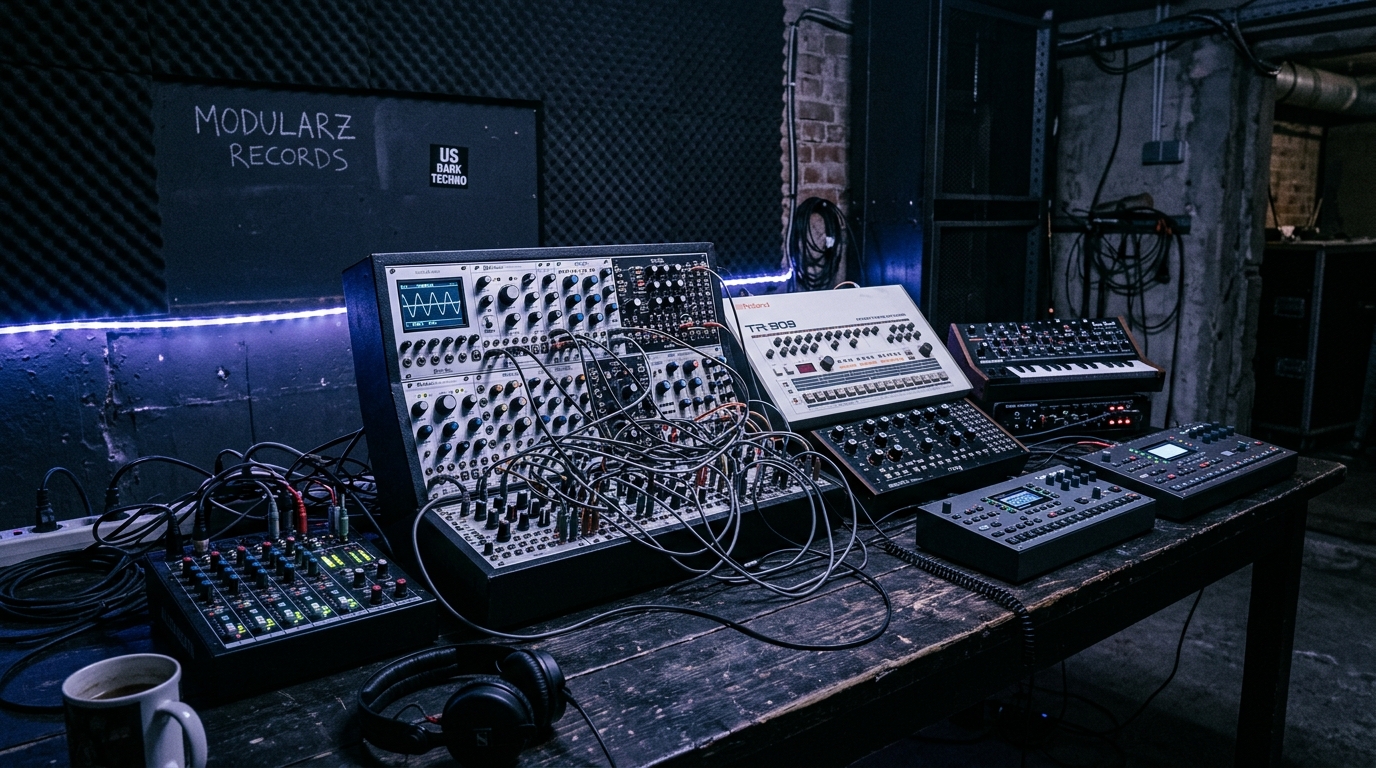
Few American techno labels carry the weight that Modularz does. Founded by Silent Servant in 2009 and rooted in Los Angeles, the Modularz techno label Developer Silent Servant has spent over fifteen years building a catalog that sounds like it was pressed in a bunker: airless, uncompromising, and completely allergic to trend. While European imprints dominate conversations about dark techno, Modularz proves that some of the genre’s most severe and rewarding output has always come from the American underground. Developer, Silent Servant, and a tight circle of producers have shaped a label identity so specific that hearing a Modularz release blind is like recognizing a voice in a dark room.
Understanding Modularz Records’ Influence
Modularz Records has influenced techno by proving that a small, vinyl-focused American label can command international respect without chasing scale. Listed on Resident Advisor since its 2009 founding, the label has operated from the United States with a release schedule that prioritizes intent over volume, building a following that now sits just under 1,000 RA followers, a modest number that wildly understates its cultural footprint.
The label’s impact registers most clearly in how it connected the Los Angeles post-punk and industrial underground to European techno infrastructure. Where labels like Ostgut Ton or Tresor drew power from Berlin’s club ecosystem, Modularz drew from a different well entirely: the darkness of Southern California’s warehouse scene, the coldness of deathrock, the discipline of Detroit. That combination didn’t exist anywhere else.
What Makes Modularz Unique?
Modularz uniqueness comes from its refusal to separate techno from its adjacent subcultures. The label treats post-punk, industrial, and EBM not as influences to reference but as structural DNA. Most dark techno labels borrow the aesthetic; Modularz artists actually lived in those scenes before making club music. That biographical reality shows up in the records, which carry a conviction that pastiche never achieves.
Key Contributions to Techno Culture
The label’s contributions to techno culture include establishing a viable American pipeline for the kind of austere, hardware-driven techno that was previously associated almost exclusively with Berlin and the Netherlands. Modularz also demonstrated that a label could maintain a coherent sonic identity across more than a decade without becoming predictable. Each release shares a tonal family resemblance, but no two records solve the same problem the same way. That’s harder than it sounds, and most labels that attempt it end up sounding like parodies of themselves within five years. Modularz hasn’t.
Silent Servant: The Visionary Behind Modularz
Silent Servant is the Los Angeles-based producer, DJ, and label head who founded Modularz and serves as its primary curatorial voice. His background in the LA punk and deathrock scenes of the late 1990s and early 2000s gave him a framework for understanding underground music that most techno producers simply don’t have: one built on physical community, zine culture, and a deep suspicion of commercial ambition.
His artistic vision shapes every aspect of the label, from its stark visual identity to its roster decisions. I’ve watched Silent Servant DJ at 3 a.m. in a concrete room where the monitors were the only light source, and the set felt less like a performance than a séance. That sensibility, the sense that the music is channeling something rather than performing it, runs through everything Modularz releases. It’s the same instinct that connects labels like Spazio Disponibile to a deeper tradition of techno as ritual rather than entertainment.
Who is Silent Servant?
Silent Servant’s identity is inseparable from Los Angeles underground culture. Before techno, he was embedded in the city’s goth and industrial scenes, and that lineage informs his production style: sparse, emotionally heavy, built on negative space rather than saturation. His solo releases on Sandwell District and Hospital Productions established his reputation before Modularz gave him full curatorial control. He is not a techno tourist who adopted darkness as a brand; he arrived at techno already carrying it.
Silent Servant’s Artistic Philosophy
Silent Servant’s philosophy centers on restraint as a form of intensity. His approach to music rejects the maximalism that dominates much of contemporary raw industrial techno, favoring instead a skeletal architecture where every element earns its presence. A recent example: his remix of Developer’s “Edificio” on Modularz strips the original to its tensile core, rebuilding it as something colder and more deliberate. That’s the ethos in miniature. Remove until what remains is load-bearing.
Key Artists of Modularz Records
The key Modularz artists form a tight roster unified by shared aesthetic commitments rather than genre orthodoxy. Developer stands alongside Silent Servant as one of the label’s most prolific contributors, and the catalog includes producers who operate at the intersection of techno, noise, and industrial. The label has never carried a large roster; it functions more like a crew than a traditional imprint, which keeps quality control unusually tight.
This selectivity matters. In an era where labels sign anyone with a SoundCloud following and a Bandcamp page, Modularz operates on a model closer to the 1,000 True Fans framework: a small, deeply committed audience that buys vinyl and shows up to the right rooms. The label doesn’t need 50 artists. It needs the right five.
Notable Artists on the Label
Developer is the most prominent Modularz artist besides Silent Servant, with multiple EPs on the label that define its harder, more percussive edge. Phase Fatale, whose work bridges Modularz’s sensibility with the Berlin scene centered around Berghain’s Säule floor, has also contributed to the label’s identity. These producers share a commitment to analog-heavy production and a willingness to let tracks breathe at tempos that sit around 128 to 135 BPM, slower and more deliberate than the 140+ speeds that dominate much of today’s industrial techno crossover.
Emerging Talents from Modularz
Modularz emerging talents are difficult to name precisely because the label doesn’t operate on a discovery model. It doesn’t scout; it absorbs. New names appear on the catalog only after extended creative proximity to the label’s core circle. This means that by the time a producer debuts on Modularz, they’ve already internalized the label’s sonic language. The result is a catalog with almost no weak entries, which is rare for any imprint that’s been active since 2009.
The Sound Aesthetic of Modularz
The Modularz sound is defined by cavernous reverb, skeletal percussion, and an emotional register that sits somewhere between dread and meditation. It is dark techno stripped of theatrics: no horror-movie samples, no gratuitous distortion for its own sake. The darkness here is structural, embedded in the frequency choices and the negative space between hits. I’ve played Modularz records back to back with Berghain-era material, and the difference is immediate. The Berlin sound fills the room. The Modularz sound empties it.
That emptiness is the point. Where many dark techno labels push toward density, Modularz production leans into absence, creating tracks that feel like they’re pulling the listener inward rather than pushing outward. The aesthetic has more in common with ambient music’s spatial logic than with peak-time techno’s wall-of-sound approach.
Defining the Modularz Sound
The Modularz sound definition begins with low-end weight and ends with restraint. Kick drums are tuned deep, often below 50 Hz, giving tracks a physical presence that registers in the chest before the ears process it. Hi-hats are sparse or absent entirely. Melodic elements, when they appear, lean toward minor-key drones or single-note sequences that repeat with hypnotic patience. The closest sonic relatives are labels like Fachwerk Records in their commitment to reduction, though Modularz trades Fachwerk’s clinical precision for something rawer and more emotionally exposed.
Production Techniques Used by Artists
Modularz production techniques lean heavily on analog hardware: drum machines, modular synthesizers, and outboard effects processing that introduces the kind of unpredictability digital production works to eliminate. Artists on the label favor recording live passes rather than programming sequences note by note, which gives the tracks a subtle rhythmic imperfection that software-based production rarely achieves. Tape saturation and spring reverb appear frequently, adding warmth to an otherwise cold palette. The result is techno that sounds handmade, which in 2026 is a more radical statement than it should be.