Blawan has never been one to soften the blow. With Sick Elixir, the Yorkshire-born producer channels the weight of losing multiple friends into a body of industrial techno that feels less like an album and more like a controlled collapse. As Resident Advisor’s best music roundup for 2025 noted, Blawan “takes industrial techno to its extremes to process the passing of multiple friends.” This is Blawan industrial techno Sick Elixir at its most personal, the record serving as both an exorcism and an archive of pain pressed into wax.
Understanding Grief Through Industrial Techno
Industrial techno expresses grief by turning emotional weight into physical force. The genre’s mechanical repetition, abrasive textures, and relentless low-end create a sonic environment where denial, anger, and numbness can exist simultaneously without needing lyrics to name them. The Kübler-Ross model of five grief stages maps surprisingly well onto the dynamic arc of an industrial techno set: the numb loop of denial, the distortion-heavy fury, the quiet breakdown before the kick returns.
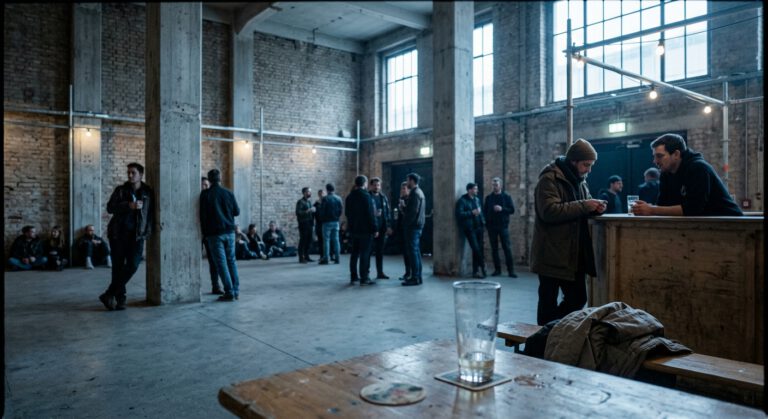
This isn’t music therapy in any clinical sense. It’s closer to what happens at 3 a.m. in a concrete basement when the room collectively surrenders to a sound that refuses comfort. Producers like Surgeon, Regis, and the entire Birmingham school understood this decades ago. Blawan’s contribution is making the grief explicit rather than ambient.
What is the grief cycle in music?
The grief cycle in music refers to how compositions can mirror the psychological stages of loss: denial, anger, bargaining, depression, and acceptance. In electronic music, these stages manifest through structural choices. A track might open with a hypnotic, dissociative loop (denial), escalate into distorted chaos (anger), strip back to near silence (depression), and resolve into a steady, accepting pulse. Blawan sequences Sick Elixir so that the album itself moves through these phases across its tracklist, not just within individual cuts.
How does industrial techno express emotions?
Industrial techno conveys feelings through texture, dynamics, and sheer physical impact rather than melody or harmony. Where melodic techno’s emotional core relies on tonal beauty, industrial techno uses noise, saturation, and rhythmic aggression as its emotional vocabulary. A kick drum clipping at -3 LUFS doesn’t ask you to feel something; it forces a physiological response. That involuntary flinch, that chest compression, is the genre’s version of emotional expression. It bypasses interpretation and hits the nervous system directly.
Blawan’s Unique Sound Design Techniques
Blawan’s production techniques center on hardware-driven sound mangling, heavy use of granular synthesis, and extreme distortion chains that push audio manipulation beyond conventional limits. His approach shares DNA with producers like Wallis on ARA label, who has spoken about embracing sound-mangling plugins and esoteric approaches to designing sounds in the industrial-adjacent techno space. But where many producers use distortion as seasoning, Blawan treats it as architecture.
I’ve sat with Sick Elixir on studio monitors and on a club system, and the difference is telling. On monitors, you hear the detail: the granular fragments, the frequency notches carved into hi-hats, the way his kicks seem to fold in on themselves. On a system, all that detail becomes pressure. The sound design techniques serve the body as much as the ear.
What production techniques does Blawan use?
Blawan’s production methods include running analog signals through chains of distortion and saturation, using granular synthesis to fracture vocal and percussive samples into unrecognizable textures, and designing kicks that occupy a wide frequency range from sub-bass to upper mids. His textured soundscapes come from layering these processed elements at varying densities. The result is audio that feels unstable, like a structure bearing too much weight, which is precisely the point when the subject matter is grief.
How does sound design convey grief?
Sound design expresses grief by creating sonic environments that mirror internal states. A pad that slowly decomposes through granular processing can evoke the way memory degrades. A kick that distorts past the point of tonal clarity can feel like the moment composure breaks. In Sick Elixir, Blawan uses these techniques deliberately. The sound design grief connection isn’t metaphorical; it’s structural. Each texture carries emotional information the way a face carries expression, without needing to explain itself. Producers working in hard techno and peak-time techno often reach for similar tools, but rarely with this level of emotional intentionality.
The Emotional Narrative in Sick Elixir
Blawan tells a story musically by treating Sick Elixir as a sequenced emotional narrative rather than a collection of club tracks. The album moves through distinct phases of intensity and withdrawal, creating a narrative arc that mirrors the non-linear experience of processing loss. There is no tidy resolution. The final tracks don’t arrive at peace so much as exhaustion, which is more honest than most grief narratives in any medium.
I’ve played records from this album at 4 a.m. and watched the floor go quiet in a way that isn’t disengagement. It’s absorption. People stop moving and start listening, which in a techno context is the highest form of engagement. The musical storytelling works because it never announces itself.
How does Blawan tell a story musically?
Blawan’s storytelling techniques rely on dynamic shifts in rhythm, density, and tonal color rather than conventional melodic development. A track might build for six minutes only to collapse into a field of static and sub-bass, mimicking the way grief ambushes you mid-routine. The thematic exploration across Sick Elixir follows an emotional logic: heavier, more aggressive tracks cluster early, while later cuts allow more space and air. This sequencing creates listener engagement through contrast, not climax.
What themes of grief are explored?
The themes of grief present in Sick Elixir include loss, disorientation, anger, and a grudging form of acceptance that never fully resolves. Unlike albums that use grief as aesthetic backdrop, Blawan’s work treats it as the structural principle. Tracks don’t reference sadness; they inhabit it. The absence of vocal content or lyrical signposting means the grief themes arrive through rhythm and texture alone, which makes them harder to dismiss and easier to project personal experience onto. This is what separates Sick Elixir from records that merely sound dark: the darkness here has a specific origin and a specific cost.
Audience Reception and Emotional Impact
Listeners connect with Sick Elixir through a process closer to catharsis than casual listening. The audience emotional impact is visceral and often described in physical terms: chest tightness, involuntary stillness, a sense of being held inside a sound rather than hearing it from outside. The album’s inclusion in Resident Advisor’s best music of 2025 confirmed what club floors already knew: this record hits differently than standard industrial fare.
The listener connection runs deeper than genre appreciation. People who have experienced loss recognize something in these tracks that casual listeners might mistake for mere aggression. That recognition is the album’s real power, and it explains why Sick Elixir generates conversation in spaces that rarely discuss underground beats in emotional terms.
How do listeners connect with Sick Elixir?
Fans interpret Blawan’s music as a mirror for their own experiences with loss, finding personal resonance in the album’s refusal to offer easy comfort. The listener connection to Sick Elixir is less about identifying with a specific narrative and more about recognizing an emotional temperature. Online discussions consistently describe the album as “heavy” in both sonic and emotional registers. That dual weight is what makes the connection feel authentic rather than performed.
What impact does it have on audiences?
The impact on audiences ranges from catharsis to deep reflection, with many listeners describing the experience of hearing Sick Elixir in a club as transformative. Common emotional responses include a sense of release, a feeling of being understood without words, and a physical exhaustion that mirrors post-grief fatigue. In a genre that often prioritizes function over feeling, Blawan’s album proves that the two are not mutually exclusive. The floor moves, but it also mourns. That combination is rare, and it’s why this record will be referenced for years as a benchmark for emotional depth in industrial techno.