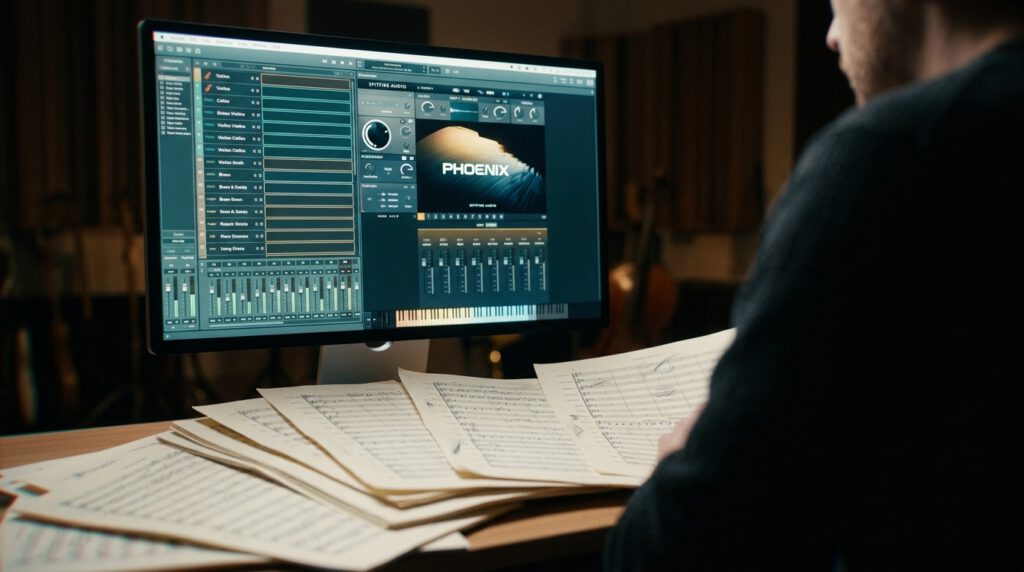
Spitfire Audio and BT have released Phoenix, a hybrid software synthesizer that marks the third collaboration between the British sample library company and the Grammy-nominated composer, producer, and technologist. Following Phobos in 2017 and Polaris in 2022, Phoenix arrives with a sharper focus: cinematic sound design built for producers who want genuine hands-on control over how a sound evolves, rather than simply how it sits in a mix.
The source material alone makes Phoenix worth paying attention to. BT contributes decades of private archive recordings spanning vintage synthesizers, samplers, cassette, and vinyl material. Spitfire brings 50 instruments across strings, brass, woodwind, choirs, guitars, pianos, and tuned percussion — but not the kind of safe, middle-of-the-road scoring palette that fills out library catalogues. The orchestral content pushes toward the edges, with frozen strings, quarter-tone clusters, and bowed textures that sit at the outer limits of conventional pitch. The combination of BT’s personal archive and Spitfire’s more experimental orchestral recordings gives Phoenix a source pool that is already loaded with character before a single synthesis parameter is touched.
Phoenix is built on six synthesis engines: a spectral wavetable engine, a six-operator FM engine with 34 algorithms, a multi-sampled instrument engine drawing on both libraries, a dedicated transient engine using 2OP FM, a subharmonic generator, and a complex noise oscillator. That range is broad enough to push the instrument in genuinely different directions depending on what a producer needs, from dense orchestral mutation to purely electronic sound design. There is also a deep cross-modulation bus with 20 modes covering FM, AM, ring modulation, phase distortion, wavefolding, and more, which means the six engines are not operating in isolation — they can be set against each other to produce results that neither could reach alone.
The architecture that separates Phoenix most clearly from other hybrid instruments is its stereo-from-the-ground-up design. Each of the instrument’s 16 voices carries two complete synthesis chains, one per channel, so the left and right sides of a sound can be shaped and modulated independently. Key parameters can diverge across channels, producing spatial movement, detuning, spectral modulation, and phase warps that are built into the synthesis itself rather than applied as an afterthought through a stereo widener or reverb tail. The result is that motion and spatial complexity become part of the note’s actual structure. Composers can create sounds that drift, bloom, and pull apart across the stereo field without needing to layer additional processing after the fact.
Phoenix also supports 16-voice full MPE, which opens the instrument to expressive performance controllers and adds another dimension of real-time control over how individual notes behave. Combined with the stereo wavetable processing, modal resynthesis, and the cross-modulation bus, the instrument is clearly designed for material that changes over time — sounds that smear, evolve, and become something different from where they started.
This is the third time BT and Spitfire have built something together, and each release has moved the collaboration into different territory. Phobos leaned heavily into granular and spectral processing. Polaris brought a more atmospheric, textural quality. Phoenix appears to occupy a more volatile space — less interested in settling into a mood and more interested in what happens when high-quality source material is systematically taken apart and reassembled through a synthesis engine designed for exactly that kind of transformation. BT himself described it as “a dream inspiration engine,” which suggests the instrument is as much about unexpected results as it is about precise control.
For producers working in film, television, and sync, or for electronic artists who want orchestral material that does not sound like a scoring library on autopilot, Phoenix makes a credible case for itself. The combination of BT’s archive, Spitfire’s orchestral depth, and an architecture built around stereo mutation rather than static playback puts it in a category that very few instruments currently occupy.
Sources: Magnetic Magazine, Latest from MusicRadar