Portola Music Festival returned to San Francisco’s Pier 80 on September 26–27, completing its fifth year as one of the most distinctive electronic music events in the country. Produced by Goldenvoice — the company behind Coachella and Stagecoach — the festival has grown steadily since its 2022 debut, which featured Flume, Jamie xx, and The Chemical Brothers. This year’s edition raised the stakes considerably, pulling in Swedish House Mafia, Fatboy Slim, Tiësto, Robyn, Zara Larsson, and JT across two nights on San Francisco’s industrial waterfront.
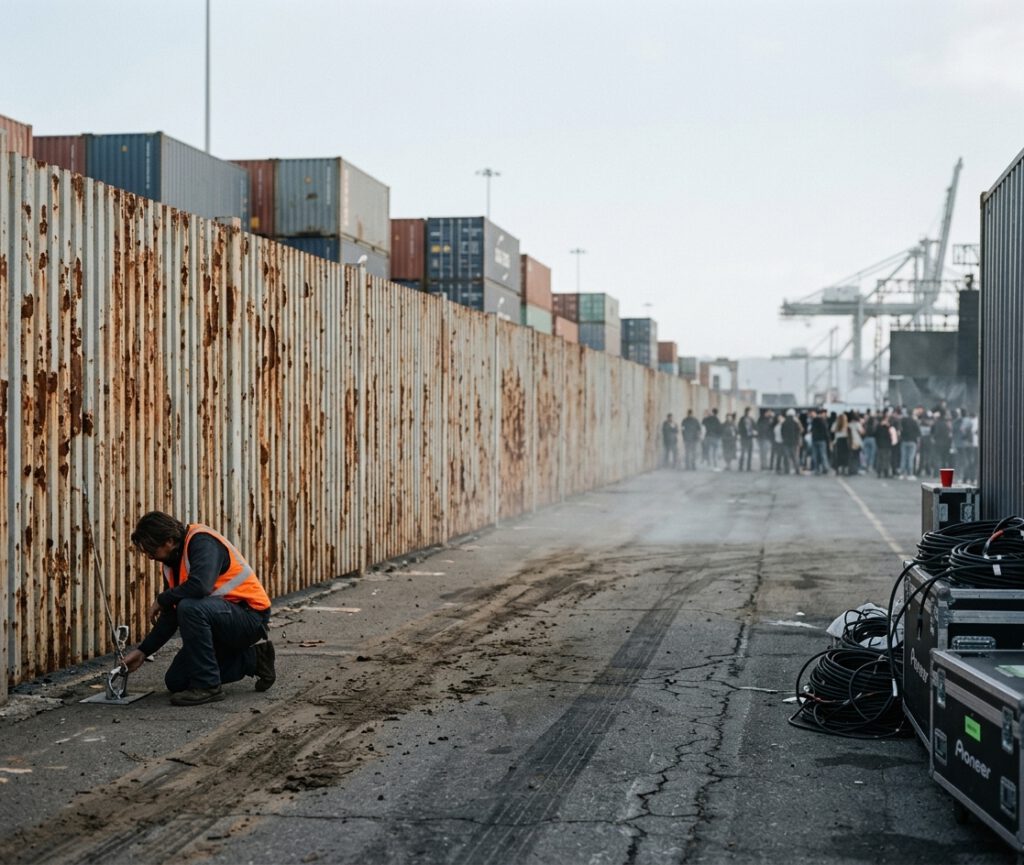
The festival’s name is itself a nod to the city’s history. Portola references the 1909 Portola Festival, which marked San Francisco’s recovery from the 1906 earthquake. More than a century later, the modern version carries that spirit of civic celebration forward, transforming a working shipyard into a gathering point for electronic music culture. Cranes, ships, heavy winds, and the city’s signature fog form the backdrop — a setting that gives the event a character few festivals can replicate.
Five stages spread across Pier 80 offered attendees a range of environments and experiences. The outdoor Pier and Crane stages provided open-air space to move freely, while the Ship Tent offered shelter from the elements. The Warehouse — a 225,000-square-foot building retrofitted to hold up to 18,000 people — was widely regarded as the festival’s beating heart. Chloe Caillet delivered a bouncy, energetic set there, Marlon Hoffstadt (performing as Daddy Trance) brought a visually and sonically striking performance, and Four Tet closed out the stage on Sunday. Tucked into a far corner of the festival grounds, the Despacio stage offered something more intimate: a checkered dance floor, a massive disco ball, and a circular sound system that made the space feel like a portal into a different era of club culture entirely.
Beyond the headliners, this year’s edition made a clear statement about who is pushing electronic music forward. Artists including VTSS, Ninajirachi, Six Sex, underscores, and Kelala brought hard dance, experimental electronics, and pop-adjacent sounds to the forefront, with their sets drawing enthusiastic crowds. Dog Blood — the project of Skrillex and Boys Noize — and Kettama also featured across the weekend, rounding out a lineup that balanced mainstream draw with more adventurous programming.
One of the weekend’s most talked-about elements had nothing to do with the music itself. Portola’s American Sign Language interpreters became a genuine highlight, matching the physical energy of the performances they were translating rather than simply standing to the side of the stage. Watching interpreters work through bass-heavy sets from artists like Six Sex, Dog Blood, Kettama, and Chloe Caillet — capturing rhythm, movement, and rapid transitions through their own physicality — was, for many attendees, one of the most memorable visual experiences of the weekend. The festival also provided dedicated viewing areas and additional communication services, making accessibility a visible and active part of the event rather than an afterthought.
Portola also surprised festivalgoers with a skating rink on the Pier 80 grounds, an unexpected addition that fit surprisingly well within the festival’s industrial aesthetic. New activations, off-site programming, and local food vendors further filled out the weekend, giving the event a texture that extended well beyond the stages. These details — small and large — contributed to what made this year’s edition feel less like a standard festival and more like a self-contained world built from disco balls, fog, and concrete.
Five years in, Portola has settled into something that feels genuinely its own. It pays homage to the underground roots of San Francisco’s dance music scene while operating at a scale that draws international headliners. That balance — between spectacle and subculture, accessibility and edge — is what keeps the festival relevant and worth the trip to the waterfront.
Sources: Magnetic Magazine, EDM Identity