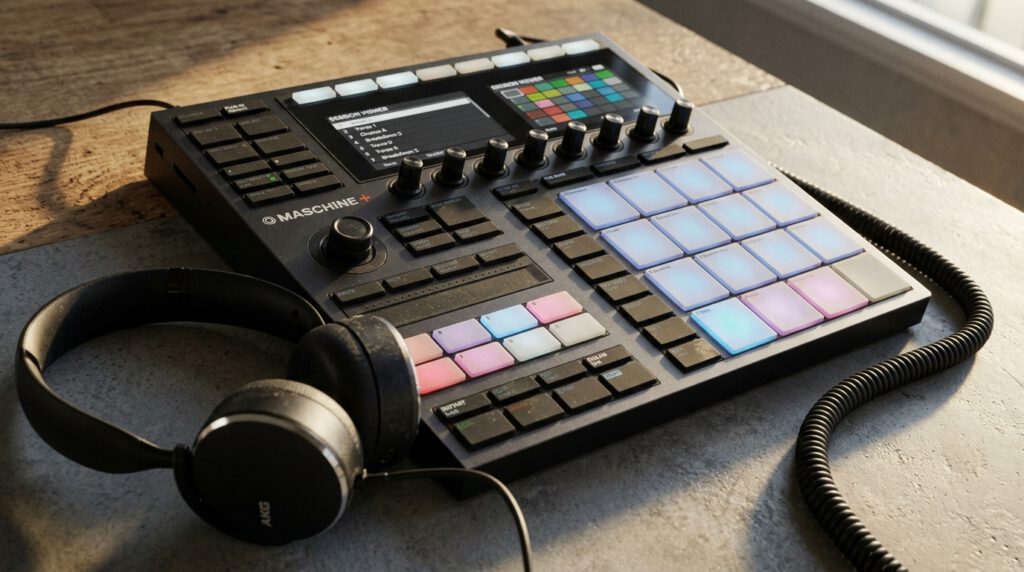
Native Instruments has released Maschine 3.7, the platform’s first significant feature update since the company was acquired by InMusic earlier this year, arriving alongside three new Expansion packs and a broader celebration of the brand’s 30th anniversary. The update is free for existing Maschine 3 users and introduces a set of creative sequencing tools aimed at breaking producers out of blank-grid paralysis.
The InMusic acquisition came after what MusicRadar describes as “a turbulent few years of leadership changes, mergers and financial struggles” for Native Instruments. InMusic brings NI into a roster that already includes Moog, Akai, Rane and Alesis, with the promise of greater stability for a brand whose flagship product lines — Kontakt, Traktor and Maschine — remain among the most widely used in music technology. It’s worth noting that Maschine 3.6 did land after the acquisition was announced, though that update was largely limited to compatibility fixes, bug patches and audio improvements rather than new features. 3.7 is the first update to meaningfully push the software forward under new ownership.
The headline additions are three sequencing tools built around probability and pattern generation. A Random Note Generator lets producers set odds and have Maschine propose melodic, percussive or chord patterns from scratch, with velocity randomisation also available as a variable. Note Event Chance assigns individual probability values to each note in a sequence, so the pattern shifts slightly on every loop pass — and a Probability Lock function lets users capture a specific randomised cycle the moment it sounds right. Rounding out the trio is a Euclidean Sequencer, which distributes rhythmic events as evenly as possible across a defined number of steps, with a real-time mode allowing step length, event count and rotation to be adjusted while the loop runs.
MusicRadar is candid about the context: all three features are already available in other major DAWs and sequencers, and there’s a sense that Maschine is still catching up following what the outlet calls the “underwhelming rollout of Maschine 3.0.” Native Instruments appears conscious of that perception. The official press release leans directly into reassurance, framing the update with the phrase “New update. New sounds. Continued support. Maschine is alive and evolving” — language that reads less like marketing copy and more like a direct message to a user base that has been watching the platform’s trajectory with some anxiety.
Alongside the software update, Native Instruments is dropping three Expansion packs simultaneously, which the company describes as one of the biggest single content releases in Maschine’s history. Thirty is the anniversary centrepiece — a collection built entirely by resampling sounds from across NI’s own back catalogue, drawing on Reaktor, Massive X, the Spotlight Series, the Play Series and more to assemble 30 Maschine kits. Paris Heat takes a French house angle, aimed at producers working in forward-facing club music. Rage Circuit, created with GRAMMY-winning producer Snipe Young, covers rage and hypertrap territory.
Each Expansion follows Native Instruments’ established format: genre-specific packs built by a single credited artist or sound designer, constructed from real analog gear, vinyl and tape, and mixed to a unified sound so that every loop, kit, one-shot and synth preset sits together without additional processing. The packs also function inside any DAW, not just within the Maschine environment.
Tim Adnitt, Senior Director of Product Management at Native Instruments, framed the release as a moment of gratitude as much as product announcement: “30 years is a moment worth celebrating. This milestone couldn’t be reached without the producers and musicians who took NI’s instruments and made history with them. Maschine 3.7 gives those producers and musicians new ways to write, sequence, and perform.”
Native Instruments traces its origins to 1996, when it released Generator — the precursor to what would become Reaktor — as its first software instrument. Three decades on, the company is navigating a significant ownership transition while trying to demonstrate that its most producer-facing platform still has momentum. Whether 3.7’s sequencing additions are enough to fully satisfy a community that has been waiting for more substantial movement is another question, but the direction is clear: NI wants Maschine’s future under InMusic to look like an evolution, not an afterthought.
Sources: Decoded Magazine, Latest from MusicRadar