Fifty years on from its original release, Jean-Michel Jarre is bringing Oxygene back to the world in a form worthy of its legacy. The 50th anniversary edition of the album — one of electronic music’s most consequential records — is set for release on 20 November via BMG, and it arrives loaded with new formats, fresh perspectives and a remaster built from the ground up.
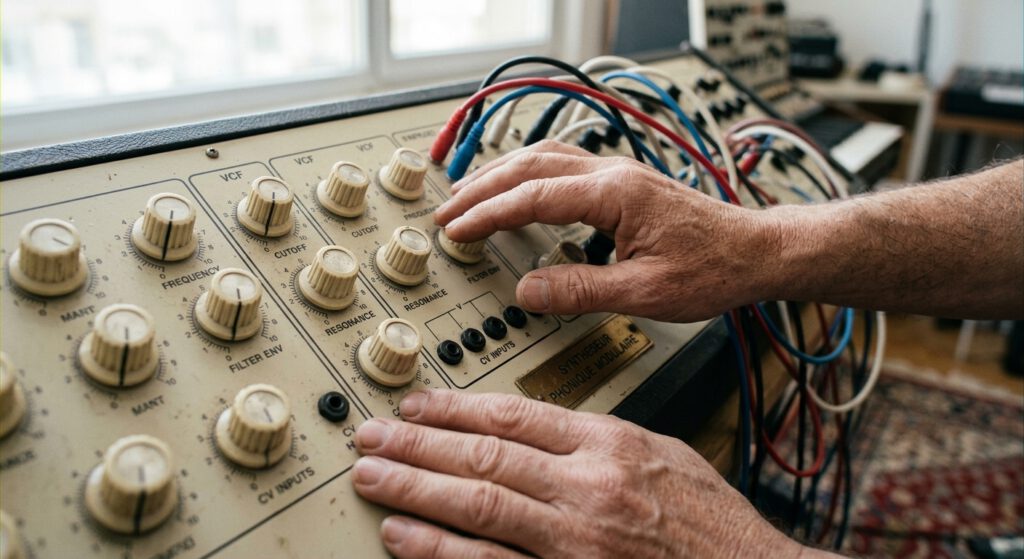
The story of Oxygene begins, improbably, in a kitchen. Jarre recorded the album in the former kitchen of his Paris apartment using an eight-track tape machine, a homemade mixing desk, and a modest but potent collection of instruments: the ARP 2600, the EMS VCS3 and Synthi AKS, a Farfisa organ, a Mellotron — broken, as it happens — and a Korg Mini-Pops. Released in France in 1976 and internationally in 1977, the album went on to sell more than 18 million copies worldwide, pulling electronic music out of the avant-garde and into the mainstream consciousness.
At the centre of the anniversary package is a new 2026 stereo remaster, drawn directly from the original tapes. The 180g black-vinyl edition has been half-speed mastered and cut by Miles Showell at Abbey Road Studios. Alongside that sits a Dolby Atmos version — the first time Oxygene has received this treatment — mixed by David Kosten, Steven Wilson and Jarre himself for Distant Swimmer. A new 5.1 mix is also included. Jarre has been clear about the philosophy driving the project: “When I created Oxygene, I was working directly with analogue instruments and tape, and the sound had a particular depth, movement and life of its own. For this anniversary edition, we returned to the original tapes with the aim of preserving that character rather than changing it.”
The full release comes in several configurations: half-speed vinyl, limited-edition coloured eco-vinyl, CD, digital editions, and a deluxe Blu-ray mediabook housing the Dolby Atmos mix, the 5.1 mix, the stereo remaster and selected archival material.
The anniversary edition also gathers a remarkable set of written reflections on the album’s meaning and reach. Guardian critic Alexis Petridis, who has contributed new liner notes, recalls Oxygene entering the British singles chart in 1977 sounding like “a curious transmission from the future.” He goes further: “Oxygene wasn’t just an exceptionally good album. It was an album that felt like a strange kind of culmination, on which Jean-Michel Jarre managed to capture and tie together every extant aspect of electronica into 40 minutes of music.” Rolling Stone’s Alma Rota takes a more poetic angle, writing that “the record becomes image, concert, architecture. It ceases to be merely a recorded object and becomes a universe that every era reinvents.” German writer Torsten Groß cuts to the bone with perhaps the most striking line of all: “The foundation for this unique career was laid in that kitchen — with a broken Mellotron and ideas for eternity.” Electronic artists Kelly Lee Owens and Solomun have also contributed separate reflections on the album and its continuing influence.
Before the album drops, Jarre will appear as guest of honour at the Amsterdam Dance Event on 21 October, where he will perform and speak on the history of electronic music and its future in the age of AI. Three days after Oxygene‘s release, on 24 November, his book Machines: A History of Electronic Music will follow — making the final months of 2025 a significant moment of reflection for one of the genre’s most enduring figures.
Half a century after a man sat in his kitchen with a broken Mellotron and a reel of tape, the music he made still demands to be heard. The formats have changed. The original tapes have not.
Sources: Latest from MusicRadar, Decoded Magazine