
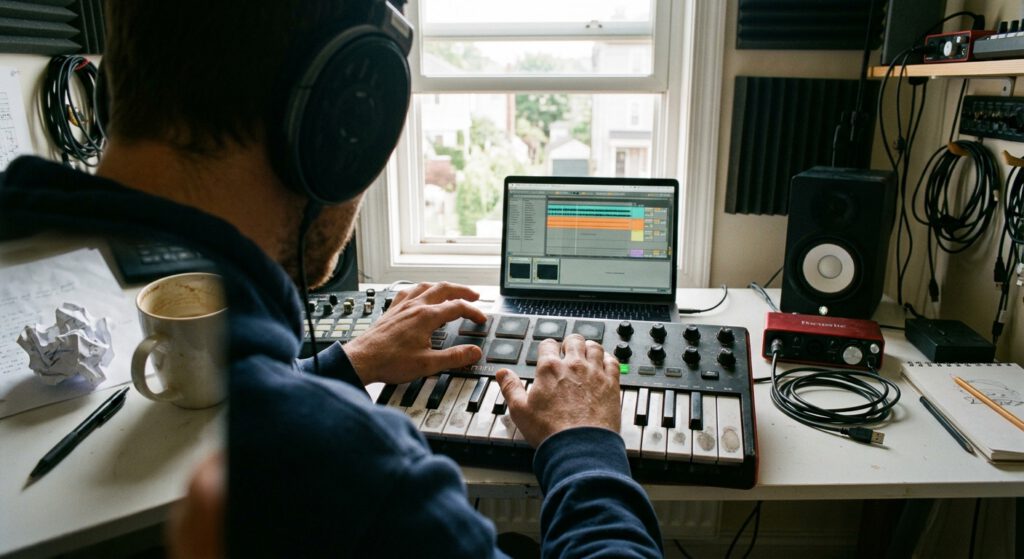
D1RT TH13F is the new electronic project from Nico Allard, a Belfast-born, Mexico City-based artist with more than two decades of work spanning indie rock, folk, pop and soundtrack production. Drawing on West African music, Latin rhythms, post-punk and ambient influences, Allard brings a songwriter and instrumentalist’s perspective to house music rather than a genre-first approach. The project’s debut single, Hold On, is out now.
The track was built across two DAWs. Allard began the demo in Ableton Live, using it to chop loops and establish the rhythmic framework quickly, before moving into Universal Audio’s LUNA for piano, vocals, guitars and synth parts. That division reflects a working method rooted in analogue tape: committing to sounds early, bouncing decisions rather than leaving options open indefinitely, and treating tracking as a fundamental part of the creative process rather than something to defer.
Percussion on Hold On was constructed with intentional looseness. Rather than building a fixed drum pattern, Allard layered individual elements designed to push against one another, deliberately pulling back precision where the groove felt too locked in. The arrangement is largely repetitive by design, with movement generated through elements entering and disappearing, shifts in ambience, stereo placement and subtle textural changes rather than announced transitions.
The harmonic centre of the track is a piano sourced from a beta plugin Allard describes as slightly obscure, chosen specifically because its tone was imperfect rather than pristine. Synth parts were built around the piano rather than in competition with it, with Allard’s harmonic thinking remaining songwriter-oriented even within a house structure. The Arturia CS-80 V appears late in the record — a simple, repetitive lead line held back until the arrangement had space for it to register as something new rather than another layer of texture.
Soundtoys Pan Man handles stereo movement on the chorus, set to move across two bars at 120 BPM. The intention was to widen the section without adding another instrument, with the panning slow enough to function below conscious notice. Allard notes that slow modulation in house music is frequently undervalued — movement operating over one or two bars can feel subconscious where faster rates simply draw attention to the effect itself.
The UAD Studer A800 tape emulation was applied to the drum bus to unify the track’s individual percussion elements. With a large number of separate parts in the mix, Allard used the Studer to add shared texture, light compression, saturation and softened transients — qualities drawn from direct experience working with analogue tape, where those characteristics were inherent to the recording process rather than added as aesthetic choices in post-production.
Source: Magnetic Magazine