NEW YORK
2026 music scenes from San Francesco to Berlin have thrown this obvious question of the DJ booth is enough. Not completely, obviously. Clubs still work.
Warehouse sets still matter. Music lovers and party goers will still give it up to the loud music and strobe lights on a DJ night. That part is not disappearing.
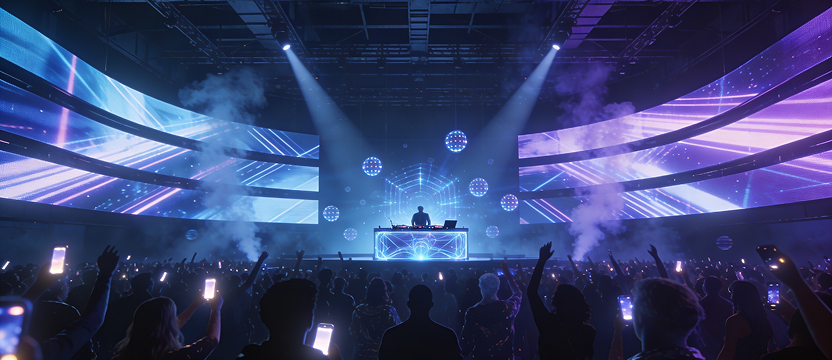
But something else is happening now around electronic music. Bigger. Stranger. More cinematic. The modern headline DJ is no longer just playing tracks. They are building worlds. And honestly, 2026 feels like the year the industry fully crossed that line.
A lot of this shift became impossible to ignore after Anyma finished his massive residency at Sphere earlier this year. The eight-night run was marketed around The End of Genesys, a hyper-visual live experience built specifically for the Sphere’s gigantic 16K wraparound screen system. Sphere Entertainment Official Venue Details
Videos from those shows spread everywhere online almost immediately. Giant humanoid figures climbing through digital skylines. AI-style faces staring directly into the crowd. Entire environments folding and collapsing around the audience. Half concert. Half science-fiction film.
People who attended kept describing the same thing afterward: it did not feel like watching a DJ set anymore. And that observation matters.
Because for almost two decades, electronic music culture mostly focused on sound design, drops, transitions, and stage energy. Visuals existed, sure, but usually as support systems around the music itself. Now the visuals are becoming part of the narrative. Sometimes the main narrative.
Right after the Sphere shows ended, Anyma pushed things even further by announcing the new ÆDEN 2026, a word tour. The entire concept revolves around massive digital spaces, cinematic visuals, moving architecture, and tightly synchronized storytelling designed to pull people completely inside the experience.
Nobody says “laser show” anymore.
Now it is:
- world-building
- immersion
- visual storytelling
- cinematic environments
- multi-sensory experience
Even the marketing vocabulary changed.
And it is not only melodic techno artists pulling crowds into this kind of hyper-visual territory now.
ILLENIUM recently confirmed a nine-night ODYSSEY run at Sphere starting March 2026. But even the way the project is being described feels different from normal tour promotion. Less “concert announcement,” more science-fiction campaign rollout. One teaser from the official launch described the entire thing as a space where “the music becomes the dialog.”
Sounds overdramatic at first. Then you watch what crowds react to now and suddenly it makes sense.
People already got used to giant LED walls years ago. Festival culture burned through that shock factor very quickly. Bigger screens. More pyro. More fireworks. Eventually everything started looking the same after midnight.
So artists had to find another way to overwhelm audiences emotionally. That is where this “immersive environment” idea really exploded. You are not just watching visuals anymore. The entire room is supposed to feel alive around you for two hours.
Bass music is heading into the same territory too, only with heavier aesthetics attached to it. Excision pushed that direction aggressively through the Nexus Tour, which outlets like EDM.com called one of the most technically insane productions of his career. Giant synchronized lasers. Real-time rendering systems reacting live during performances. Stages designed more like dystopian game environments than traditional festival setups.
Honestly, some of the footage barely looks real anymore. And underneath all this spectacle, there is a business reality driving it too.
Festival lineups became overcrowded. Audiences started seeing the same names repeated everywhere. Same drops. Same visual language. Same formulas stretched across different cities. At some point, headliners alone stopped being enough.
A recent analysis covered by Music Business Worldwide talked about growing demand for “shared physical experiences” instead of passive attendance culture. Which honestly sounds corporate on paper, but the basic point is true. People want environments now. Something they can disappear into for a night instead of just filming for Instagram Stories.
Technology also finally caught up with ambition.
Companies like Disguise Systems are already building systems capable of controlling visuals, lighting, stage movement, and rendering engines almost simultaneously during live shows. Ten years ago, most of this would have looked impossible outside cinema production budgets.
Now it is entering the festival infrastructure.
And the money around it is becoming enormous. According to projections published by Grand View Research, the immersive entertainment display market is expected to cross $4.4 billion globally by the end of 2026.
That number alone tells you this is no temporary gimmick.
Electronic music is slowly shifting away from “watching DJs” toward stepping inside constructed worlds for a few hours. And honestly, younger crowds seem completely ready for that transition.
This is no longer only about rave culture. It is becoming an entertainment infrastructure. And honestly, maybe this evolution was inevitable.
Streaming changed listening habits. TikTok shortened attention spans. Audiences became visually trained by phones, gaming engines, cinema universes, and hyper-digital environments. Standing under static lights watching a DJ mix for 90 minutes simply does not hit younger crowds the same way anymore.
They want scale. Narrative. Escape. Something that feels impossible for a little while. Which is probably why electronic music suddenly looks less like club culture and more like live science fiction.