Home recording has never been more accessible, and MusicRadar’s Recording Week 2026 has arrived with a wave of practical guidance aimed squarely at producers taking their first steps into the world of capturing audio at home. Across tutorials covering essential gear, microphone technique, and the fundamentals of digital audio, one message rings clear: a little preparation and knowledge goes a very long way.
Before a single note is recorded, the groundwork matters. One of the most overlooked tools in any beginner’s setup is already sitting in their pocket. The smartphone — whether iPhone or Android — functions as an instant idea-catcher, capable of grabbing a melody or lyric the moment inspiration strikes. iPhone users benefit further from cloud integration, meaning a rough vocal idea hummed on a street corner can be waiting on your desktop by the time you get home. It won’t replace your DAW, but it keeps creativity from slipping away between the moment of inspiration and the moment you sit down to record.
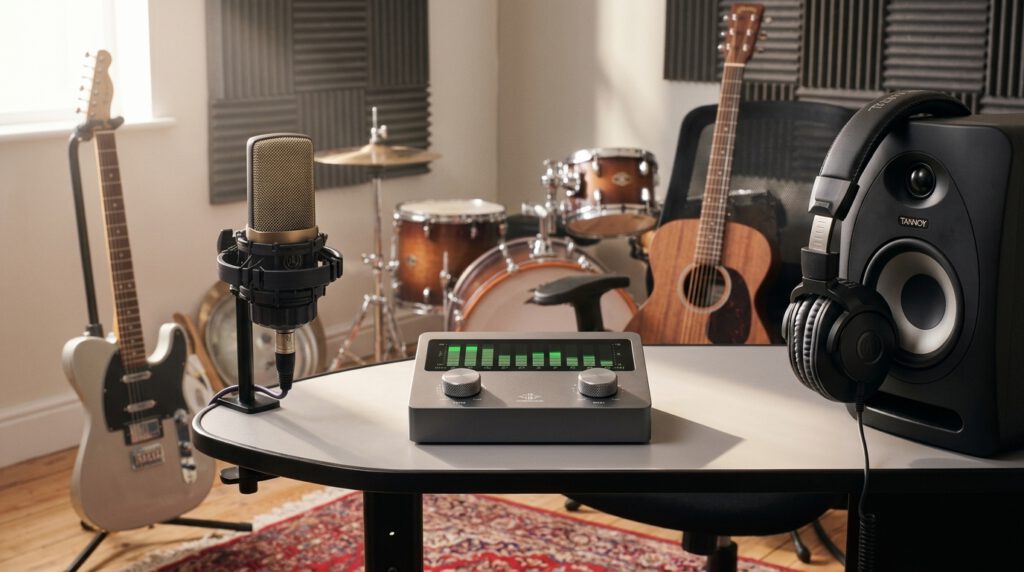
When it comes to building that recording setup, the temptation to cut costs with a USB microphone is understandable — but an audio interface offers considerably more flexibility. These external boxes connect to your computer and open the door to the far wider world of XLR microphones. Beyond the expanded hardware options, they provide physical gain controls and dedicated headphone outputs with their own volume pots, giving you hands-on control that software alone rarely replicates as intuitively. For anyone serious about developing their home studio over time, an audio interface is a smarter long-term investment.
Once the gear is in place, microphone placement becomes the next frontier — and it’s one where even limited equipment can produce strong results with the right approach. Recording a full drum kit with a single microphone is entirely possible. A cardioid condenser positioned overhead above the drummer will capture the full kit, while experimenting with distance determines how much room ambience bleeds into the sound. Pull back for a wider, more atmospheric feel; move in close for something tighter and more controlled.
Two microphones open things up considerably. Producer and engineer Bob Clearmountain, whose credits include The Rolling Stones and Bruce Springsteen, uses a method that places a high-output dynamic mic — his preference is a Shure Beta 52 — at the bass drum, and a cardioid condenser such as a Neumann M49 overhead, pointing down across the toms and snare. It’s a stripped-back approach that consistently delivers professional results. For those with a larger mic collection, dynamic mics with cardioid patterns work well on kick, snare, and large toms placed two to six inches away, while small diaphragm condensers suit hi-hats and cymbals at four to six inches.
Piano and guitar share more in common from a miking perspective than many beginners expect. Both require attention to the balance between bass and treble frequencies. For an upright piano with a single microphone, placing it centrally at the front — up to 12 inches away, ideally with the front panel removed — captures a natural overall sound. If mechanical key noise becomes a problem, repositioning the mic up and over to aim directly at the strings inside the instrument can help clean things up significantly.
Underpinning all of this practical technique is a working understanding of how digital audio actually functions. Sound begins as pressure waves moving through air, which a microphone’s transducer converts into an electrical signal. That analogue signal — continuous and smooth — then needs to be translated into something a computer can read. This is achieved through pulse code modulation (PCM) and analogue-to-digital conversion (ADC), a process that samples the incoming waveform at regular intervals and converts those measurements into numbers. The sampling rate determines how many of those measurements are taken per second; CD-quality audio runs at 44,100 samples per second, producing a digital representation close enough to the original that the difference is largely imperceptible.
Understanding that relationship between analogue sound and digital data helps explain why decisions made at the recording stage — gain levels, microphone placement, interface quality — have such a direct impact on what ends up in your DAW. As MusicRadar notes, someone with no production knowledge can still identify a weak mix simply because it sounds less polished than other tracks. Getting the fundamentals right from the start is what separates recordings that translate well from those that don’t, regardless of how much processing comes later.
Recording Week 2026 makes a compelling case that home recording success isn’t about having the most expensive gear — it’s about understanding what you have, using it deliberately, and building good habits from day one.
Sources: Latest from MusicRadar, Latest from MusicRadar, Latest from MusicRadar